Roof Leak Repair: Temporary Fixes Until a Roofer Gets There
If your roof is leaking right now, work from the inside first. Put a container under the drip, relieve any bulging ceiling with a small hole, move what matters out of the way, and photograph everything before you touch it. Climbing onto a wet roof in the dark is how a $600 repair becomes a hospital visit. Tape, sealant and a tarp are all daylight jobs, done on a dry surface, and every one of them is a way to buy time rather than a repair.
The short version
- Inside beats outside. Containing water and documenting damage does more for you tonight than anything you can do on the roof in the rain.
- Flex Seal is not a gimmick, but it is not a repair. Its maker says so in writing: the products “are not a permanent fix for significant structural damage or full-roof repairs.” Used as a stopgap on a dry surface, that is a fair description of what it does.
- Nearly all of these products want a clean, dry surface, which a leaking roof in a rainstorm is not. That single conflict is why most DIY patches fail.
- The warranty story you have read is probably wrong. GAF’s current shingle warranty says it “remains in effect” even after improper work. The real risk is different, and we quote it below.
- For hail, stop and photograph. Hail damage is an insurance matter, not a warranty one, and a sealed-over hole is a weaker claim.
The first hour, in order
The order matters more than the materials.
- Contain it. A bucket, a bin, a cooler. Put an old towel in the bottom so the drip stops drumming and splashing.
- Relieve a bulging ceiling. A sagging, heavy patch of drywall is holding pooled water. Puncture the low point with a screwdriver and catch it in the bucket. This feels wrong and is right: a controlled hole you can patch is better than a ceiling that lets go all at once.
- Photograph before you clean up. Wide shot of the room, close-up of the stain, a photo of the bucket filling. Date-stamped photos are what an adjuster wants, and the mess is the evidence.
- Get into the attic with a torch. Water travels along rafters and sheathing before it drops, so the wet spot on the ceiling is often not under the hole. Trace the water uphill to the highest wet point.
- Mark the spot. A nail pushed up through the decking, or a chalk circle, tells a roofer in thirty seconds what might otherwise take an hour to find.
That last step is worth more than any product in this article. The reason DIY roof patches so often fail is not bad sealant; it is sealing the wrong place, because the leak entered the roof several feet uphill of where it appeared.
Does Flex Seal actually work on a roof?
This is the question everyone asks, because you can buy it at any hardware store in Middle Tennessee on the way home. The fair answer is: yes, as a temporary measure, within limits the manufacturer states plainly on its own website.
Flex Seal’s own product pages say Flex Seal products “can be used to seal minor roof leaks, especially for temporary or quick fixes,” and that Flex Tape “can help temporarily stop roof leaks.” They also say this, in a note on the same page:
“Flex Seal products are not a permanent fix for significant structural damage or full-roof repairs. If your roof has significant wear or ongoing leaks, have a roofing professional assess the damage.”
And on Flex Tape specifically: “While it’s a quick and effective solution, it’s recommended to follow up with a more permanent repair for long-term protection.”
That is the manufacturer setting the expectation, not a roofer talking down a rival product. Read it that way and the product does exactly what this article is about: it buys you time. What it will not do is fix a roof.
The catch nobody mentions: dry surfaces
Here is the practical problem. Flex Seal says its spray “works best on clean, dry surfaces, but can be used on wet surfaces in emergency situations,” and that Flex Tape should be applied “to a clean, dry area” and pressed down firmly. Every adhesive product on that shelf says something similar.
A roof leak announces itself during a rainstorm. The surface is wet, the shingles are slick, and the granules are loose. Applying tape or sealant to a wet, dirty, cold shingle is a common reason these products get blamed for failing: the product is being used outside the conditions its own label sets.
So the honest sequence is: contain the water tonight, and put the patch on tomorrow when the surface is dry, if you can safely reach it at all.
What about a hail hole?
For hail, the calculation changes completely, and not because of the product. Hail damage is an insurance claim, and your claim rests on an adjuster being able to see what the hail did. Sealing a punctured or bruised shingle with black rubberised paste before anyone has documented it makes the damage harder to assess and the claim harder to argue.
If hail has holed your roof: photograph it, cover it (a tarp over the area, not sealant into the hole), and file the claim. Our guide to handling a storm damage insurance claim covers the order of operations, and the storm-chasing crews that follow every Middle Tennessee hail event are worth reading about before you answer the door.
What the shingle warranty actually says
You will read everywhere that a DIY sealant “voids your roof warranty.” We went and read the current GAF Shingle & Accessory Limited Warranty, the document itself, effective for products installed after 1 January 2025. It does not say that. Under What Is Not Covered, it opens:
“Even if your GAF Products were not properly installed according to GAF’s application instructions or to standard good roofing practices, this limited warranty remains in effect.”
It is a manufacturing defect warranty. It covers the shingle being faulty, not the roof being damaged. So a patch does not switch it off. But two other clauses matter far more to anyone standing in an attic with a bucket.
First, hail is excluded outright. The warranty does not apply to “damage resulting from causes beyond normal wear and tear, such as: acts of nature, such as hail, fire, or winds (including gusts) over the applicable wind speed.” If hail broke your roof, the warranty was never the route; insurance is.
Second, and this is the real trap:
“If you repair or replace your GAF Products before you notify GAF about your claim or before GAF has completed its evaluation of your claim, your claim may be denied.”
The warranty also requires you to notify GAF within 30 days of noticing a problem. So the risk from a DIY patch is not that it voids anything. It is that if you did have a genuine manufacturing defect, patching over it before telling the manufacturer can get that claim denied. Photograph first, notify, then patch.
Scope note: we read GAF’s current shingle warranty because GAF describes itself in that document as North America’s largest roofing manufacturer and publishes the full terms. We did not review the warranty terms of other manufacturers, and they differ: read the one that came with your roof before relying on any of this.
The fixes that actually hold
| Fix | Best for | Honest limit |
|---|---|---|
| Bucket and attic sheeting | Tonight, in any weather | Contains water; does nothing to the roof |
| Tarp over the area | Holes, missing shingles, hail damage awaiting an adjuster | Needs safe roof access and proper anchoring; will not survive high wind if loosely laid |
| Roofing tape / Flex Tape | A small, findable puncture on a dry day | Manufacturer says follow up with a permanent repair |
| Roof sealant or paste | Small cracks, gaps around a vent or flashing | Wants a clean dry surface; hides damage from an adjuster |
| Roofing cement over a patch | A lifted or cracked shingle | Messy, hard to remove, a roofer will cut it out anyway |
Flex Seal’s own guidance for bigger openings is worth repeating because it is more sensible than the adverts suggest: for larger holes, it recommends pairing Flex Paste with wire mesh so the mesh bridges the gap and the paste has something to grab. That is genuinely how a patch spans a hole rather than sagging into it.
Tarping, and the free option after a declared disaster
A tarp laid loosely over a roof and weighted with bricks is a sail. It lifts in the first gust and can take shingles with it. A tarp that holds runs from above the damage all the way over the ridge, is wrapped around a length of timber at each end, and is fastened so water runs over it rather than under it.
After a federally declared disaster, there is a free alternative worth knowing about. Operation Blue Roof, run by the U.S. Army Corps of Engineers for FEMA, installs temporary blue sheeting at no cost to eligible homeowners in declared areas. The eligibility rules are specific: primary residences with standard shingled roofs, a signed Right of Entry form, and roofs with more than 50 percent structural damage are not eligible, because at that point the building needs more than a cover. Middle Tennessee has had federal disaster declarations before, so it is worth checking whether one is active before you pay someone to tarp your roof.
Sixteen years of storms over Middle Tennessee
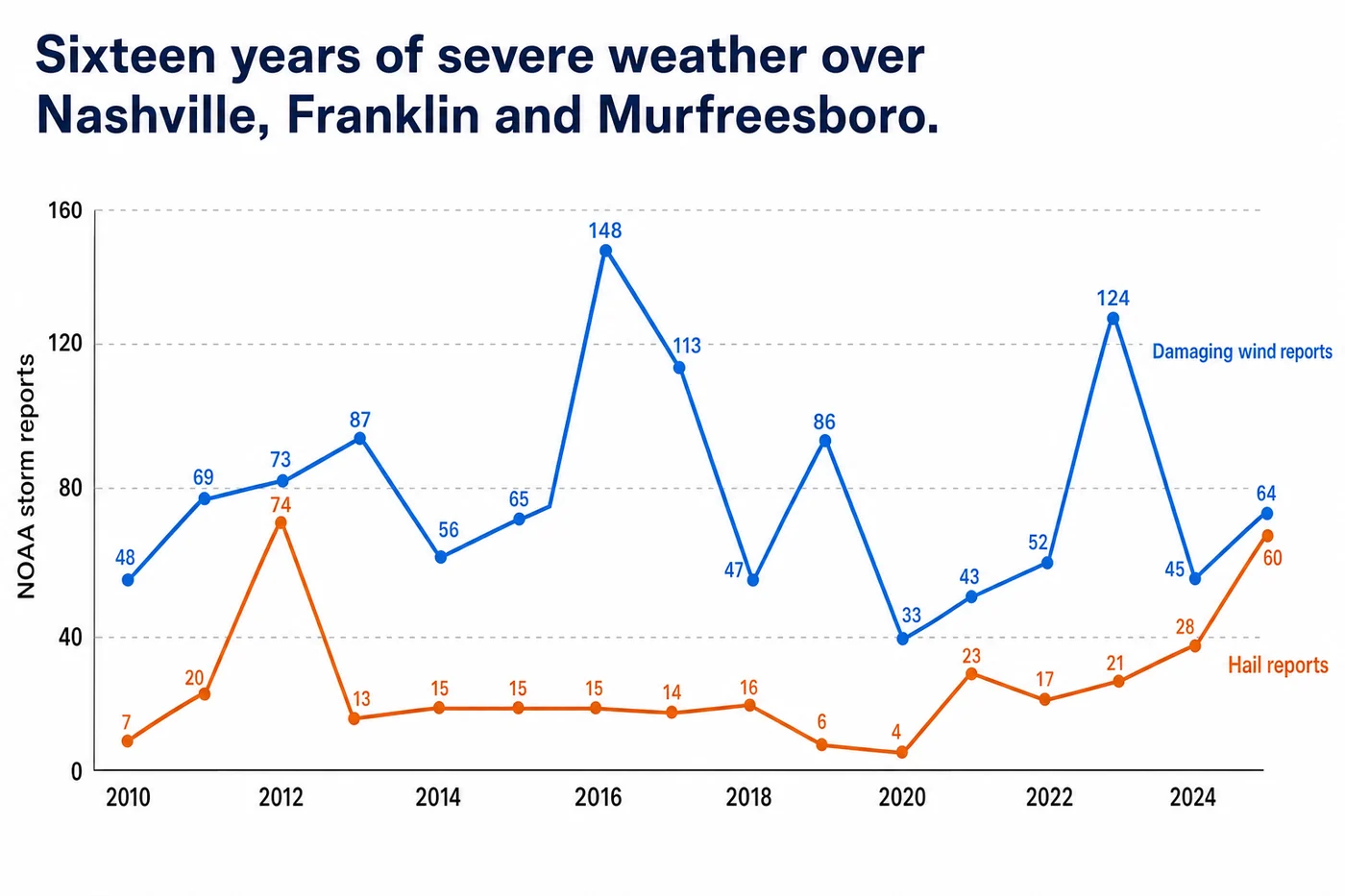
We pulled the NOAA National Centers for Environmental Information Storm Events Database, the public record that hail-map products are built on, for the three counties that contain Nashville, Franklin, Brentwood, Murfreesboro and Smyrna. Between 2010 and 2025 it records 1,556 hail, damaging-wind and tornado reports across Davidson, Williamson and Rutherford counties.
| County | Cities covered | Reports |
|---|---|---|
| Davidson | Nashville | 784 |
| Williamson | Franklin, Brentwood | 445 |
| Rutherford | Murfreesboro, Smyrna | 327 |
Two things stand out, and both are recent.
2025 was an extraordinary hail year. The database records 60 hail reports across the three counties, against a median of 16 a year over the period. Only 2012, with 74, was higher.
The afternoon of 20 May 2025 was the worst of it, and it landed on Williamson County. Between 15:20 and 15:49, under half an hour, NOAA logged 3.00-inch hail at Douglas and Peytonsville, 2.75-inch at Franklin, and 2.00-inch stones at Leiper’s Fork, Mudsink and again at Douglas. Three inches is roughly a baseball. If you own a roof in Franklin or Brentwood and have not had it looked at since that afternoon, that is the date to mention.
Williamson County has had a run of these: 3.00-inch hail at Leiper’s Fork on 26 May 2024, 2.50-inch at Craigfield on 3 April 2025, and 2.00-inch at Nolensville on 30 March 2025, the same system that dropped 2.00-inch hail on La Vergne in Rutherford County. Further back, Rutherford took 2.75-inch hail at Rucker on 18 October 2011.
Nashville’s worst entry is of a different kind. The EF-3 tornado that crossed Davidson County in the early hours of 3 March 2020 accounts for $1.09 billion in property damage in this dataset, with 2 direct deaths and 170 injuries. It is a single event worth more than every other storm in the sixteen-year window combined.
One caveat on reading any of this: these are storm reports, not damaged roofs. A single storm generates many reports, and reports cluster where people are to see them. The counts say when severe weather crossed these counties, not how many roofs it broke.
What not to do
- Do not go onto a wet or icy roof. Nothing in this article is worth a fall. If it is raining, everything outside waits.
- Do not seal over hail damage before it is documented. You are covering the evidence your claim depends on.
- Do not patch a suspected manufacturing defect before notifying the manufacturer. GAF’s warranty says that alone can get the claim denied.
- Do not pour sealant into a leak you have not traced. Water runs along framing; the entry point is usually uphill of the stain.
- Do not let anyone who knocked on your door climb up to “take a look.” Choose your own contractor.
Common questions
Does Flex Seal work on a roof leak?
As a temporary fix on a small leak, yes, within the limits its maker sets. Flex Seal’s own site says its products “can be used to seal minor roof leaks, especially for temporary or quick fixes” but “are not a permanent fix for significant structural damage or full-roof repairs.” It also asks for a clean, dry surface, which a roof in a rainstorm is not. Treat it as a way to buy time until a roofer arrives.
Will Flex Tape stop a hail hole in my roof?
It may stop water in the short term, but it is the wrong move for hail. Hail damage is an insurance claim, and covering the damage before an adjuster has seen it makes the claim harder to prove. Photograph the damage, tarp over the area rather than sealing into it, and file the claim first.
Does a DIY roof patch void my shingle warranty?
Not according to GAF’s current shingle warranty, which states it “remains in effect” even where products were not installed according to instructions or good roofing practice. The real risk is a different clause: repairing before you notify GAF of a claim can cause that claim to be denied, and notice is required within 30 days. Other manufacturers’ terms differ; read yours.
Should I put a bucket under the leak or make a hole in the ceiling?
Both, in that order, if the ceiling is bulging. A sagging patch of drywall is holding pooled water and can fail all at once. Puncturing the low point with a screwdriver and catching the water in a bucket turns an unpredictable collapse into a small hole you can patch later.
Can I get a free tarp for my roof after a storm?
Sometimes. Operation Blue Roof, run by the U.S. Army Corps of Engineers for FEMA, installs temporary sheeting free for eligible homeowners in federally declared disaster areas. It covers primary residences with standard shingled roofs, requires a signed Right of Entry form, and excludes roofs with more than 50 percent structural damage.
How long can a temporary roof fix last?
Plan in weeks, not seasons. Flex Seal recommends following up a tape repair with a permanent one, and a properly anchored tarp is generally treated as a stopgap until the roof is repaired. Middle Tennessee’s heat and freeze-thaw cycling are hard on any adhesive left exposed; see what this climate does to roofing materials.
Getting a roofer there
A temporary fix is a countdown, not a solution. Once the water is contained and the damage is documented, the next call is to someone licensed. Our Nashville roofing directory lists every company we track with its state license number and expiry date, and you can request a free quote from our sponsor, a licensed Nashville contractor. If you want to know what the eventual bill might look like, we have guides to repair versus replacement and what a roof inspection costs.
Sources
- NOAA NCEI Storm Events Database: bulk detail files, 2010–2025. Event counts, hail magnitudes, dates and damage figures for Davidson, Williamson and Rutherford counties are our own aggregation of this data. Retrieved 21 September 2026.
- Flex Seal: Will Flex Seal Fix a Roof Leak? and Does Flex Tape stop roof leaks? Manufacturer guidance and limitations, quoted directly. Retrieved 21 September 2026.
- GAF Shingle & Accessory Limited Warranty (RESWT160L), effective for products installed after 1 January 2025. Exclusions and claim-notice terms quoted directly. Retrieved 21 September 2026.
- FEMA / U.S. Army Corps of Engineers: Operation Blue Roof. Programme eligibility and scope.
This article is general information, not legal, insurance or engineering advice, and it is not a substitute for a professional inspection. Do not go onto a roof you cannot access safely. Warranty terms are quoted from the published document named above and vary by manufacturer and installation date; confirm the terms that apply to your roof. Last updated 26 September 2026.