Hardie Board Siding: What It Is, How Long It Lasts, and How to Check Yours
Hardie board is siding made out of cement. People call it Hardie, Hardie board, Hardy board, or HardiePlank. They all mean the same thing. James Hardie is the company that makes it. The material itself is called fiber cement, and other companies make it too.
It is the most common upgrade on Middle Tennessee homes right now. This guide covers what it is made of, which houses have it, how long it lasts, how to check your own walls, and which fixes you can do yourself.
The short version
- It is cement, sand, and wood fiber baked together with steam. That is why bugs and rot leave it alone.
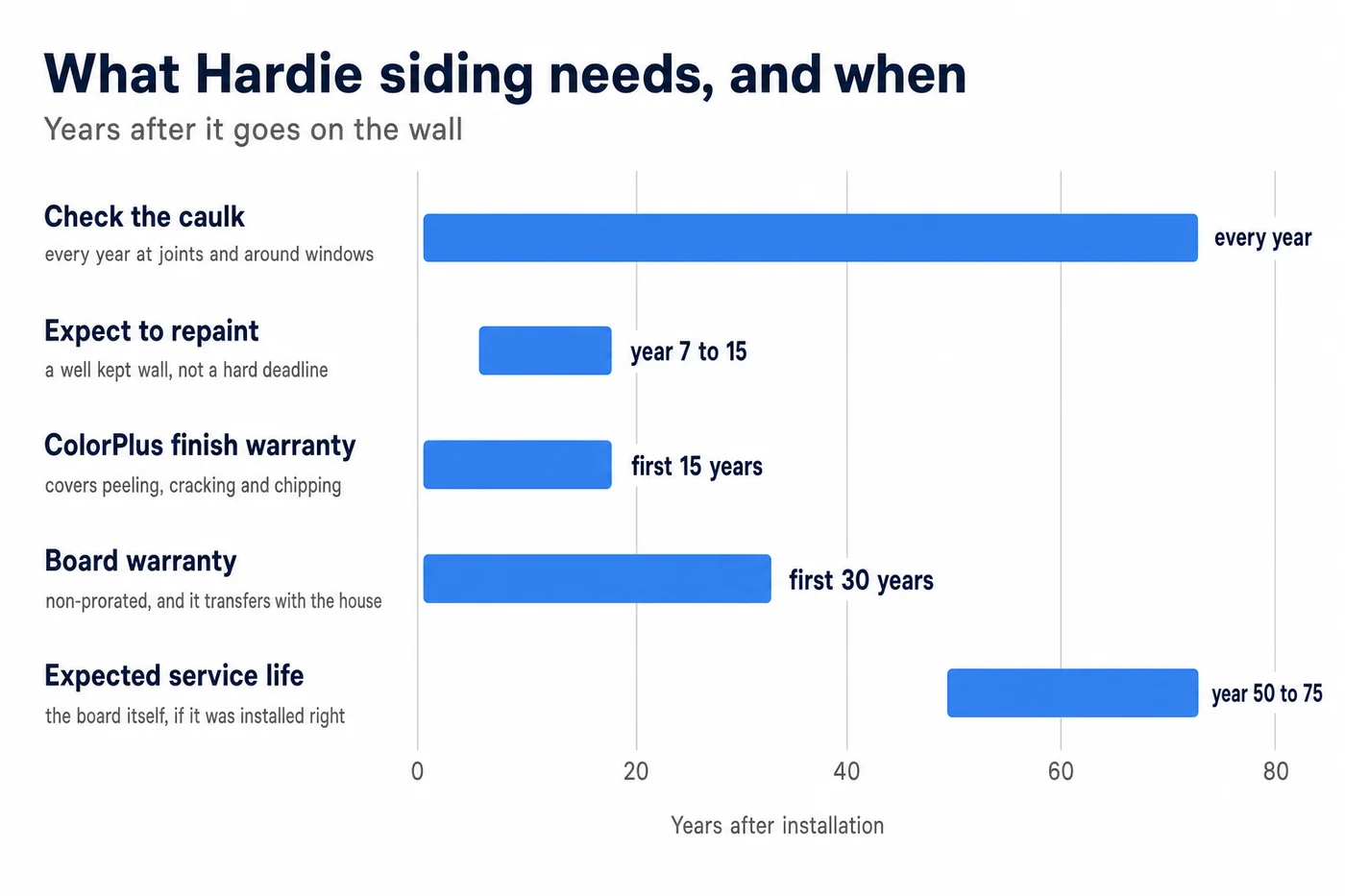
- The boards last 50 to 75 years. The paint does not. Plan to repaint every 7 to 15 years.
- Most problems are install problems, not board problems. The boards outlive bad work.
- The big one to check: there must be a 6 inch gap between the bottom of your siding and the dirt.
- Small fixes are fine to do yourself. Putting up a whole wall is not a weekend job.
What Hardie board is made of
Fiber cement has four ingredients. That is all.
- Portland cement. The same cement used in sidewalks.
- Sand. Ground fine.
- Cellulose fiber. This is wood fiber, broken down into tiny strands.
- Water.
Here is the part that matters. The wood fiber is not there to make the board look like wood. It is there to stop the board from cracking. Cement on its own is brittle. Mix in wood fiber and the board can flex a little instead of snapping.
How it gets made
The four ingredients get mixed with water into a slurry. Think of thin pancake batter.
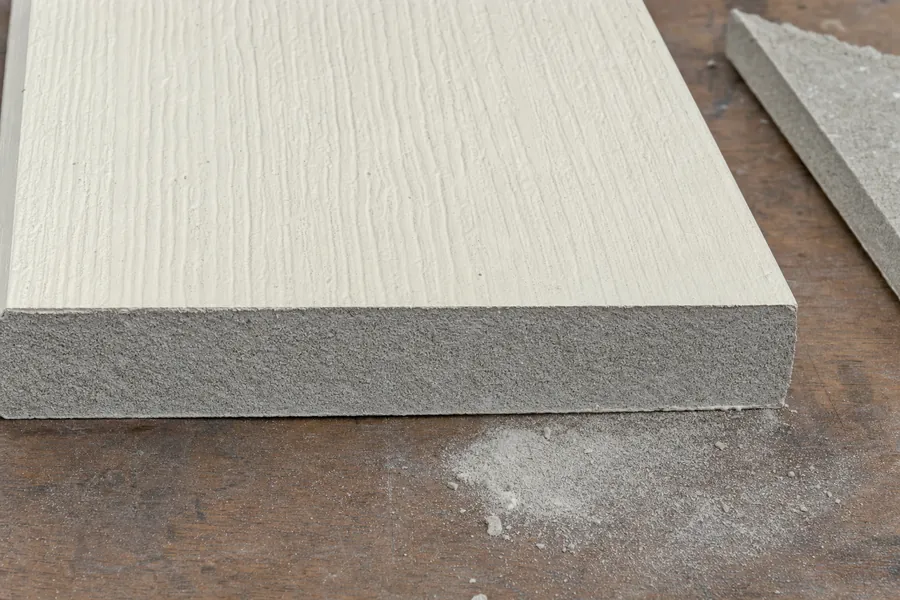
That slurry gets spread into thin layers. The layers stack up and press together into one sheet, about as thick as a finger. While the sheet is still soft, a roller can press a wood grain pattern into the face. If the maker wants a smooth board instead, they skip that step.
Then comes the step that makes the whole thing work. The sheets go into an autoclave. An autoclave is a big sealed oven that cooks with high-pressure steam. The steam curing makes the board much stronger, and it makes the board hold its shape. A cured board does not swell in summer and shrink in winter the way wood does.
Last, the sheets get cut into planks and painted at the factory.
What that gets you
Because it is basically a thin slab of cement, a few things follow:
- It does not rot. There is nothing in it for rot to eat.
- Bugs leave it alone. Termites cannot chew cement.
- Woodpeckers cannot get through it.
- It does not burn. Fiber cement carries a Class A fire rating, the best one.
- It holds paint for a long time. The surface is stable, so the paint on top stays put.
- It is heavy. This is the trade-off. A plank is much heavier than vinyl, and it takes two people and the right tools to hang it well.
Two kinds: ColorPlus and primed
You can buy Hardie board two ways, and the difference matters later when something needs fixing.
ColorPlus comes painted from the factory. The color is baked on in a controlled room. It looks even, and it lasts well.
Primed comes with a base coat only. A painter puts the real color on after the boards are on your wall.
Neither one is wrong. But remember which one you have, because you can patch a primed board yourself and you are not supposed to patch a ColorPlus board the same way. More on that below.
Which houses have it
Hardie board shows up on two kinds of homes around here.
Newer houses. Builders started using fiber cement heavily in the 2000s. If your house went up after about 2005 and the siding is not vinyl, there is a good chance it is fiber cement.
Older houses that got re-sided. This is the bigger group. When a 1990s house with failing hardboard finally gets stripped, fiber cement is usually what goes back on. Same for older homes with tired wood siding.
It also turns up as an accent. Many brick houses here have fiber cement in the gables, on dormers, or across the back of the house where the brick stops.
How to tell if you have it
Four checks, none of which take long:
- Knock on it. Fiber cement feels solid and sounds dull. Vinyl sounds hollow and gives under your knuckle.
- Push on it. Vinyl flexes. Fiber cement does not move at all.
- Look at a vertical seam. Vinyl panels lap over each other and leave an obvious overlap every few feet. Fiber cement boards meet end to end, and the seam is either caulked or covered by a thin strip of trim.
- Look at the bottom edge of a board. Fiber cement edges stay crisp and square. Hardboard swells and goes soft and furry.
Not sure what you are looking at? Our guide to every siding type in Middle Tennessee walks through all twelve materials with photos.
Where you find it in Middle Tennessee
These are patterns based on when each area was built. They are not a survey of every house, so treat them as what to expect.
- Franklin, Brentwood, and the rest of Williamson County. This is the heaviest concentration. Newer neighborhoods here used fiber cement from the start, often mixed with brick or stone on the front.
- Nolensville, Spring Hill, and Mt. Juliet. Fast-growing areas built mostly after 2000. Lots of fiber cement, lots of board and batten gables.
- East Nashville and the older close-in neighborhoods. Here it shows up as a replacement on older homes. In the strict historic districts, the smooth version is the one that gets approved. The version with wood grain stamped into it usually does not.
- Antioch, Hermitage, Smyrna, and outer Murfreesboro. These areas are full of 1980s and 1990s homes with failing hardboard. Fiber cement is the usual replacement, so it is spreading street by street as houses get re-sided.
- Green Hills and Belle Meade. Mostly brick, with fiber cement on gables, dormers, and additions.
A note on the HZ10 version
James Hardie makes its boards in two recipes for two kinds of weather. HZ5 is built for cold places with freezing and snow. HZ10 is built for the hot, wet South, and the company says it is made to resist cracking, rotting, and swelling in humid heat.
Middle Tennessee siding contractors specify the HZ10 line for homes here. James Hardie assigns the zone by ZIP code, so if it matters to you, check your own address on their zone tool or ask your contractor which line they are quoting.
How long it lasts
The boards themselves last a long time. Here is how fiber cement compares to the other siding you will find on Middle Tennessee homes.
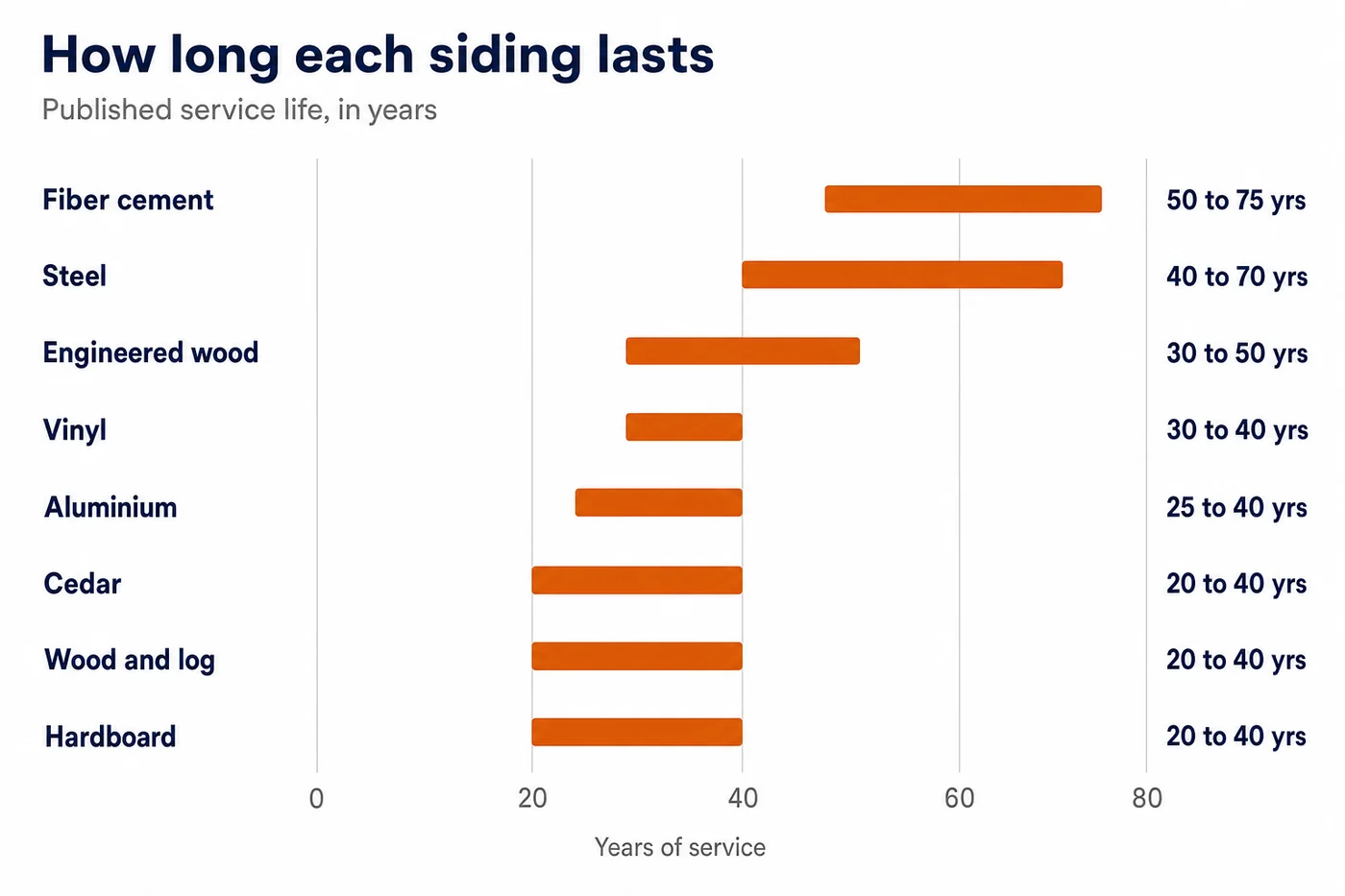
Fiber cement sits furthest to the right. Only brick beats it, and brick is left off the chart because its published life has no upper limit.
But the boards are only half the story. The paint on top wears out long before the board does, and the caulk in the joints wears out faster still. A Hardie wall is not a thing you install and forget for 60 years. It is a thing you check once a year and repaint a few times.
The warranties, in plain words
James Hardie publishes two warranties, and they cover different things.
The board warranty runs 30 years. It is non-prorated, which means it does not shrink as the years pass. A claim in year 29 is treated the same as a claim in year 2. It also transfers, so it follows the house if you sell.
The ColorPlus paint warranty runs 15 years and covers peeling, cracking, and chipping. This one also covers the labor to put it right, which is unusual and worth knowing.
Both are limited warranties with conditions attached. The most important condition is that the siding was installed the way the manufacturer says. That brings us to the real issue.
What to look for on your house
Here is the thing almost nobody tells homeowners: when Hardie siding fails early, the board is usually fine. The installation was wrong.
Water is the enemy, and these rules exist to keep water off the boards and out of the wall. All of them come straight from James Hardie’s own installation guide. You can check most of them from your yard.
The gap checks
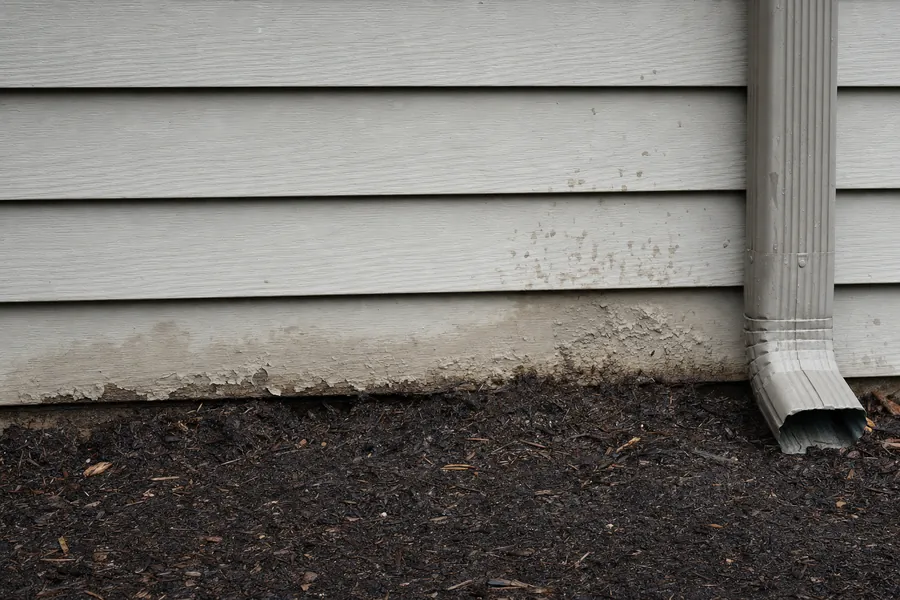
- 6 inches from the ground. This is the big one. The bottom of your siding must sit at least 6 inches above the dirt. Mulch counts as dirt. Garden beds get topped up year after year, and eventually the soil touches the siding. Once that happens, the wall stays wet.
- 2 inches from anything solid. Where siding meets a roof, a deck, a walkway, steps, or a driveway, there must be a 2 inch gap.
- A quarter inch above flashing. Where siding sits on top of metal flashing, leave a quarter inch gap so water can run off instead of sitting there.
- 1 inch from the gutter end. Gutters should not jam up against the siding.
- Never sitting in standing water. If a puddle forms against your wall after rain, that is a problem to fix.
The water checks
- Kickout flashing. Where a roof edge runs into a wall, there should be a small angled piece of metal that throws water out into the gutter. Without it, every rain dumps water straight down behind your siding. Look up at the spot where a roofline meets a wall. If there is no little metal flap there, that is worth asking about.
- Stains running down the wall. A dark streak below a joint, a window corner, or a light fixture means water is getting in above it.
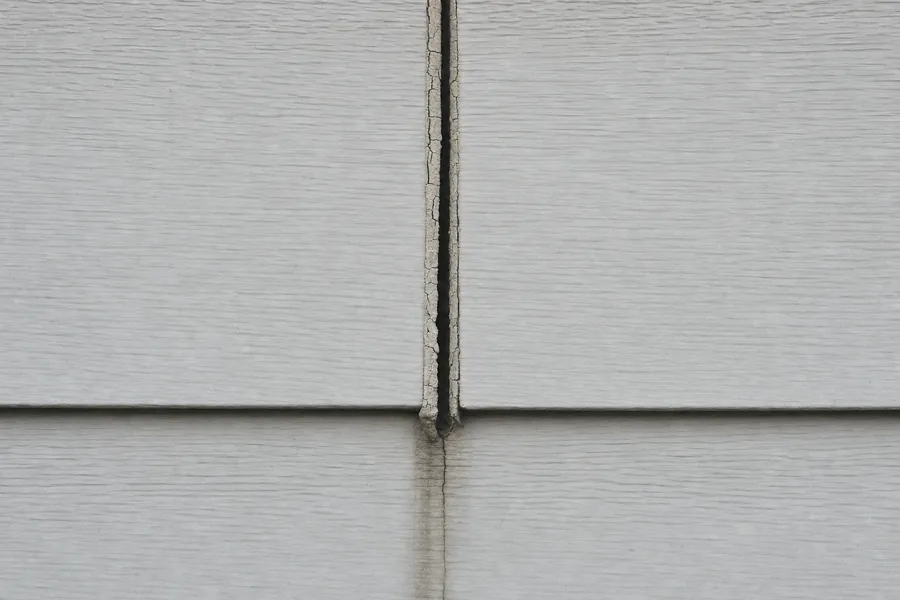
- Caulk that has pulled away. Look at the vertical joints between boards, and around windows and doors. Old caulk shrinks, hardens, and pulls off one side, leaving a gap.
Signs on the boards themselves
- Paint peeling or chalking across whole boards. Usually means the paint is simply due, not that the board is bad.
- Cracks running from nail heads. Often means the nails were driven too hard when it went up.
- A wavy, uneven wall. Usually means the nails were overdriven into soft sheathing underneath.
- Soft or crumbling board edges. This is the one that actually means the board is finished. It is rare, and it almost always shows up where one of the gap rules above was broken.
The rule of thumb: damage in one spot is a repair. Damage in the same spot on every wall is an installation problem, and fixing a few boards will not solve it.
Repairs you can do yourself
Let us be straight about this. Installing fiber cement siding is not a DIY job. The NAHB says plainly that fiber cement installations are typically not suited to do-it-yourself projects, because they need special tools and expertise. The boards are heavy, they crack if you handle them wrong, and cutting them makes dust you do not want in your lungs.
But upkeep and small repairs are a different matter. These are reasonable to take on.
Re-caulking a joint
This is the most useful thing you can do for your siding, and it is genuinely easy.
- Dig the old caulk out of the joint. A putty knife works.
- Brush the joint clean and let it dry.
- Run a new bead in and smooth it with a wet finger.
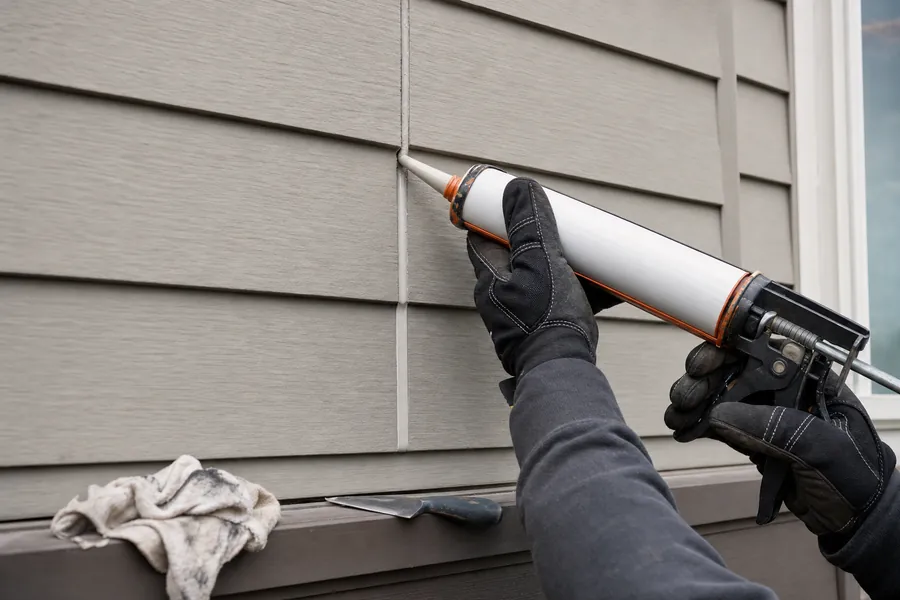
Use a caulk that stays flexible. Look for the words permanently flexible on the tube. James Hardie asks for a sealant meeting ASTM C920 Grade NS, Class 25 or higher, or a latex sealant meeting ASTM C834. Those code numbers are printed on the tube, so you can match them in the store.
Washing it
Dirt and spider nests come off with a garden hose and a soft brush. Keep the pressure low and point the water down, not up. Spraying up under the boards pushes water behind them, which is exactly what you spent all this effort preventing.
Fixing a small chip or dent
This one depends on which kind of board you have, and the difference is important.
If your siding is primed and painted on site: you can fill small dents, chips, and cracks with a cementitious patching compound, then prime and paint over the repair.
If your siding is ColorPlus: do not do that. James Hardie specifically does not approve filling nail heads, holes, dents, or cracks with caulk or patching compound on ColorPlus boards. The factory finish will not match, and you may affect the finish warranty. Touch-up pens exist, but the manufacturer says to use them only on an area smaller than a dime. Anything bigger means replacing the board.
Painting it
You can repaint fiber cement yourself. Three rules from the manufacturer:
- Use exterior acrylic paint. Not stain. Not oil-based paint. Not alkyd. Those can cause the surface to roughen, crack, chalk, or let go entirely.
- Never paint a wet board. Let it dry fully first.
- If boards went up primed, they need their real paint within 180 days. Primer is not a finish and will not protect the board on its own for long.
What to leave alone
- Cutting boards. Cutting fiber cement releases silica dust, which damages lungs over time. OSHA’s rule for professionals is a saw with a blade 8 inches or smaller fitted with a dust collector and a filter that catches 99 percent or more. If you are not set up like that, do not cut it.
- Anything above the first floor. The boards are heavy and awkward. Ladder work with a 12 foot plank is how people get hurt.
- Replacing boards in the middle of a wall. Boards overlap and are nailed through the course above. Pulling one out without damaging its neighbors takes practice.
- Anything involving flashing. Flashing is what keeps water out of the wall itself. Getting it wrong is expensive and you will not see the damage for years.
Repair or replace?
A simple way to think about it:
- Paint is failing but boards are sound. Repaint. You are not replacing anything.
- A few damaged boards, rest of the wall fine. Replace those boards.
- Caulk gone at most joints. Re-caulk the house. This is maintenance, not failure.
- Damage concentrated low on every wall. Check the ground clearance first. You may be able to fix the cause by lowering the grade instead of replacing siding.
- Soft, crumbling boards in several places, plus stains inside the house. Get it looked at properly. Water has been getting into the wall and the siding may be the smallest part of the problem.
What it costs
Fiber cement runs $6 to $15 per square foot installed, or about $15,000 to $37,500 for a 2,500 square foot house. James Hardie branded product installed runs higher, at $16 to $40 per square foot.
Two things that are often left out of a quote:
- Tearing off the old siding adds $0.70 to $2.00 per square foot. This is the single most commonly missing line on a cheap estimate.
- Rotten sheathing underneath. On anything over about 25 years old here, expect some. Ask what the rate is before work starts, not after.
We break down whole-house siding costs for every material in our Middle Tennessee siding guide.
Common questions
Is it Hardie board or Hardy board?
Hardie, with an ie. It is named after James Hardie, the company that makes it. Plenty of people say and spell it Hardy, and contractors will know exactly what you mean either way.
How long does Hardie board siding last?
The boards have a published service life of 50 to 75 years, and James Hardie backs them with a 30-year non-prorated warranty that transfers to the next owner. The paint is a different story and needs redoing every 7 to 15 years. Caulk at the joints goes sooner than that and should be checked yearly.
Can I install Hardie board myself?
Realistically, no. The NAHB says fiber cement installation is typically not suited to do-it-yourself work because of the tools and expertise needed. The boards are heavy, they crack when mishandled, and cutting them releases silica dust that needs a dust-collecting saw. Re-caulking, washing, and repainting are all reasonable to do yourself.
Why is my Hardie siding rotting at the bottom?
Fiber cement does not rot, so something else is going on. The usual cause is that the bottom of the siding is too close to the ground. The manufacturer requires at least 6 inches of clearance between the siding and the dirt, and garden beds and mulch creep up over the years until they touch. Once the board cannot dry out, the paint blisters and the edge softens. Check the clearance before you replace anything.
Can I pressure wash Hardie siding?
Gently, if at all. A garden hose and a soft brush are safer. Keep any pressure low and aim the water downward. Spraying upward forces water up behind the boards and into the wall, which causes the damage you are trying to avoid.
Can I paint Hardie board a different color?
Yes. Use a high-quality exterior acrylic paint. Do not use stain, oil-based paint, alkyd paint, or powder coating, because those can roughen the surface, crack, chalk, or stop sticking. Never paint a board that is still wet. If your siding is ColorPlus, repainting it is allowed but may affect the finish warranty, so check first.
What is the difference between fiber cement and Hardie board?
Fiber cement is the material. Hardie board is one brand of it, made by James Hardie, and it is the best known. Allura, Nichiha, and CertainTeed make fiber cement too. They are similar products, but warranties and installation details differ by brand, so do not assume what applies to one applies to another.
Getting it quoted
Three questions separate a real quote from a cheap one.
- Does the price include tearing off and hauling away the old siding?
- What is the rate if rotten sheathing turns up underneath? It usually does on older homes.
- What goes behind the boards? The drainage layer and flashing are what actually keep water out. A crew that cannot answer this is a crew to pass on.
One more worth asking: who is physically doing the work. Most siding here is sold by exterior companies that also roof and fit windows, and siding is sometimes subcontracted. Either answer is fine. Not getting a straight answer is the signal.
Our Middle Tennessee siding contractor directory lists every company we track along with its state licence number and expiry date, so you can check it against the state register yourself. You can also request free quotes to compare more than one opinion on the same walls, or start with siding contractors in Nashville.
Sources
- James Hardie and its published FAQ, for the 30-year non-prorated transferable substrate warranty and the 15-year ColorPlus finish warranty covering paint and labour. Retrieved 5 October 2026.
- The Hardie Zone System, for the HZ5 and HZ10 product lines and what each is engineered for. The zone for a given address is assigned by ZIP code through James Hardie’s own tool. Retrieved 5 October 2026.
- James Hardie General Installation Requirements, for the 6 inch ground clearance, the 2 inch clearance to roofs, decks, paths, steps and driveways, the quarter inch clearance above horizontal flashing, the 1 inch gutter clearance, kickout flashing, the 180 day painting window, approved and prohibited paint types, caulk standards ASTM C920 and C834, and the repair patching rules including the ColorPlus exception. Retrieved 5 October 2026.
- NAHB and Portland Cement Association, Concrete Homes Technology Brief No. 15: Fiber Cement Siding, for the cement, sand and cellulose composition, autoclave steam curing, the role of cellulose fibre in preventing cracking, the Class A fire rating, annual caulk inspection, repainting every 7 to 15 years, and the statement that fiber cement installation is typically not suited to do-it-yourself projects. Retrieved 5 October 2026.
- James Hardie silica safety resources and OSHA 29 CFR 1926.1153, for the Table 1 control method when cutting fiber cement with a handheld power saw: a blade 8 inches or smaller with a commercially available dust collection system and a filter of 99 percent or greater efficiency. Retrieved 5 October 2026.
- HomeGuide house siding cost guide, updated 29 October 2025, for installed cost ranges, whole-house totals, service life figures and tear-off cost. Retrieved 5 October 2026.
This article is general information, not construction or engineering advice. Warranty terms are summaries of published limited warranties that carry conditions and exclusions; read the current warranty document for your product before relying on it. Confirm your Hardie Zone and product line with James Hardie or your contractor. Cost figures are national installed ranges and will vary with your house. Last updated 5 October 2026.