Roof Repair or Replacement? How to Tell Which You Actually Need in Nashville
Repair a roof when the damage is localised, the roof is still within roughly the first two-thirds of its expected life, and the deck underneath is sound. Replace it when problems appear across several slopes at once, when the deck is compromised, or when the roof already carries two layers of covering and cannot legally take a third.
Those three tests, age, extent and deck, settle most cases before cost enters the conversation. Two building-code thresholds decide the rest, and they are different numbers doing different jobs: 25 percent of the roof covering replaced in any 12-month period forces the entire roof up to current code, and in Nashville a permit is required once you replace more than a third of the roof or add any new layer.
Most roofs that get replaced could have been repaired. Most roofs that get repaired twice should have been replaced the first time. What follows is how to tell which side of that line you are on, and why an emergency at 11pm on a Tuesday almost never means you are buying a new roof.
The three questions that decide it
Before anyone quotes you anything, these are the questions a competent roofer is answering in their head while they walk your roof.
1. How old is it?
Guidance attributed to the National Roofing Contractors Association puts the design life of most new roofs at around 20 years, with actual lifespan governed by local climate, design, material quality, installation quality and maintenance. In practice, a three-tab asphalt roof in Middle Tennessee tends to run about 20 years, architectural shingles nearer 30, and premium laminated products longer again.
The useful rule is not the number itself but where you sit against it. A roof in its first decade with a discrete problem is a repair. A roof past about 18 years showing problems in several places at once is telling you something systemic, and patching it buys months rather than years.
2. How much of the roof is affected?
This is where the widely-repeated “25% rule” comes from, and almost every article you will read gets it slightly wrong. It is not a contractor’s opinion. It is building code, and we will come to exactly what it says in a moment.
3. Is the deck sound?
The decking is the plywood or OSB under everything else. Shingles are replaceable; a rotted deck is a different job entirely. If a roofer puts a foot through a soft spot, or you have had a slow leak running for a season, the conversation changes from covering to structure, and structure wins that argument every time.
What the code actually says about 25%
The 25 percent rule does not mean a roof with more than 25 percent damage must be replaced. It means that replacing more than a quarter of the roof covering within any 12-month period requires the entire roof to be brought up to current building code.
The “25% rule” is a provision of the International Residential Code, Section R908.4 in the 2024 edition Nashville enforces, numbered R908.3.1 in the 2018 and 2021 editions you will see cited elsewhere. The wording has been stable, and it matters:
“Not more than 25 percent of the roof covering of any building or structure shall be removed and replaced in any 12-month period unless the entire roof covering is replaced and is made to conform to the requirements of this code.”
Read that carefully, because it is not what people usually think it means. It does not say a roof with 26% damage must be replaced. It says that if more than a quarter of the covering is removed and replaced within any twelve months, the whole roof has to be brought up to current code: current fastening, current underlayment, current wind and energy requirements.
That is why the economics flip at that point. Once you cross the threshold, you are not paying for a large repair; you are paying for a code-compliant roof either way. At that point replacement is usually cheaper per year of life than the repair that triggered it.
It also means something useful for you as a homeowner: a contractor who tells you a roof with three damaged squares “has to be replaced by code” is misreading the provision. Under 25%, the code is not the reason.
Nashville’s permit number is different, and it is not 25%
Here is the part that trips people up locally. Nashville has its own threshold, it does a different job, and it is a different number.
Metro Nashville’s permit schedule lists roofing as “roofing, new layer or replacing more than 1/3 of the roof”. Two things follow from that wording, and the second one catches people out:
- Replacing more than a third of the roof puts you into permit territory. Below that, routine repair generally does not.
- Adding a new layer puts you there regardless of area. Overlaying is not treated as maintenance no matter how small the section.
Metro Nashville and Davidson County currently enforce the 2024 International Residential Code and 2024 International Building Code with local amendments, adopted under ordinance BL2025-898. Confirm anything borderline with the Department of Codes and Building Safety rather than with whoever is quoting the work.
| Threshold | Where it comes from | What it actually governs |
|---|---|---|
| 25% | IRC R908.4 (2024); R908.3.1 in earlier editions | Cross it in any 12 months and the entire roof must be brought to current code |
| 1/3 | Metro Nashville permit schedule | Replacing more than a third, or adding any new layer, requires a permit |
So a repair can be permit-exempt in Nashville and still trigger the code-compliance provision. They are not the same test, and a contractor who conflates them is either careless or hoping you will not check.
The rule that quietly decides a lot of these
There is a third code provision that settles more repair-or-replace arguments than either percentage: a roof recover is not permitted where the existing roof already has two or more applications of any type of roof covering. One existing layer can generally take a second. A roof already carrying two layers has to come off to the deck.
If your house has been re-roofed twice without a tear-off, your next roof is a full replacement regardless of how localised the damage is. Ask any roofer quoting you how many layers are up there. If they have not looked, they are not quoting; they are guessing.
When a repair is genuinely the right answer
Repair is the right call when the roof is inside its expected life, the damage is confined to a small area, the cause was a discrete event rather than age, and the deck is sound. Most leaks are flashing failures rather than shingle failures, and flashing is a repair.
In full, repair is usually the sound call when all of these are true:
- The roof is comfortably inside its expected life, roughly the first two-thirds.
- The damage is localised. A handful of missing shingles, one length of failed flashing, a single penetration around a vent or chimney.
- The cause was an event, not age. A branch came down, a storm lifted a section, a previous repair was done badly. Discrete causes have discrete fixes.
- The rest of the roof looks its age and no worse. Granules still in place, shingles lying flat, no widespread curling or cupping.
- The deck is sound.
The NRCA is explicit that not all leaks require complete replacement, and that flashings and small damaged sections are commonly repairable. Most leaks are flashing failures, not shingle failures, and flashing is a repair.
When replacement stops being avoidable
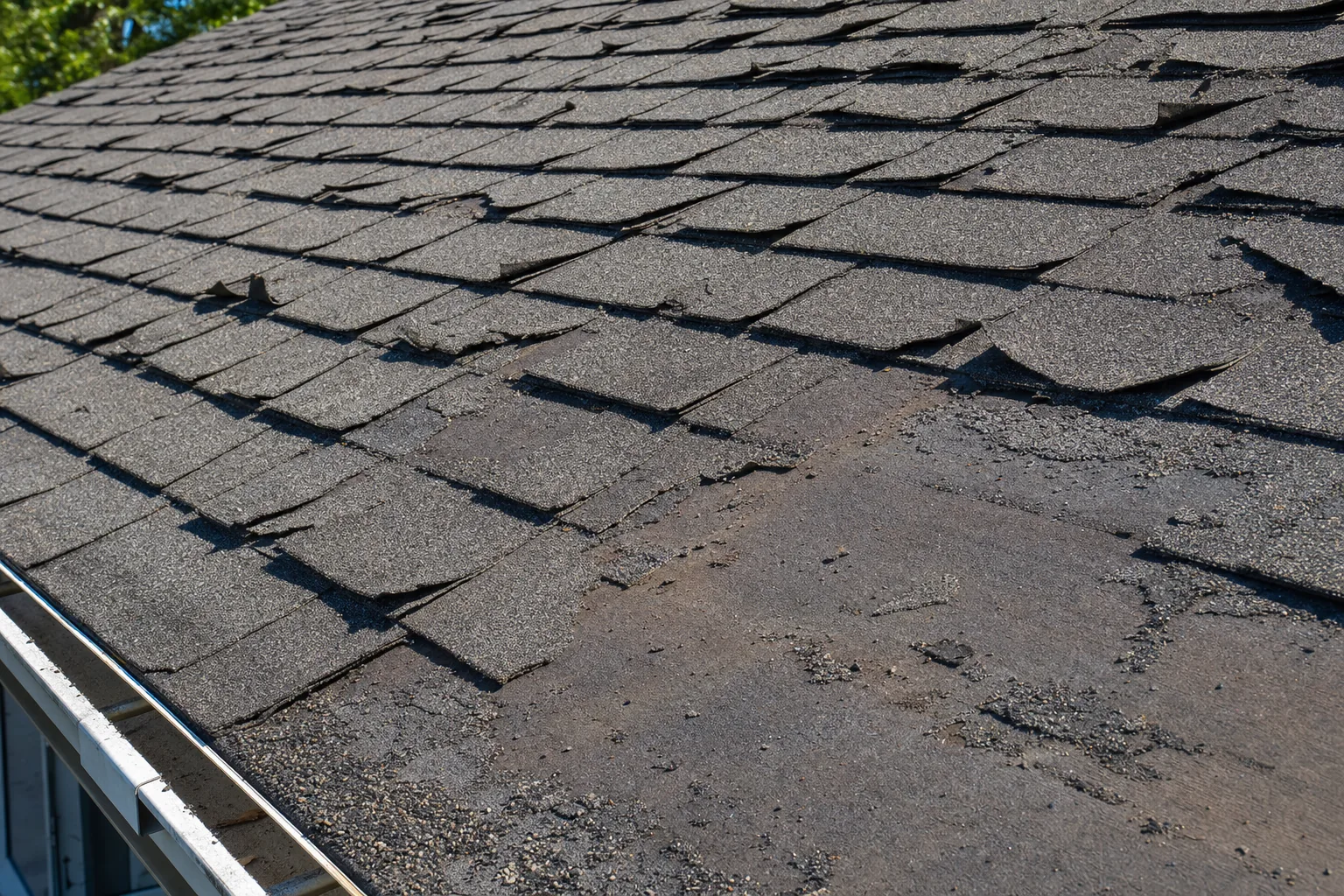
- The problems are everywhere rather than somewhere. Granule loss across whole slopes, shingles curling on multiple elevations, several leaks in unrelated places. That is the system ending, not a fault.
- The deck is compromised. Soft spots, sagging between rafters, daylight visible from the attic.
- You are already at two layers. See above.
- You are repairing repeatedly. Three service calls in two years on an ageing roof is a replacement being paid for in instalments, at worse value.
- Damage exceeds 25% and you are re-roofing to code anyway.
Emergency repair is not the same conversation as replacement
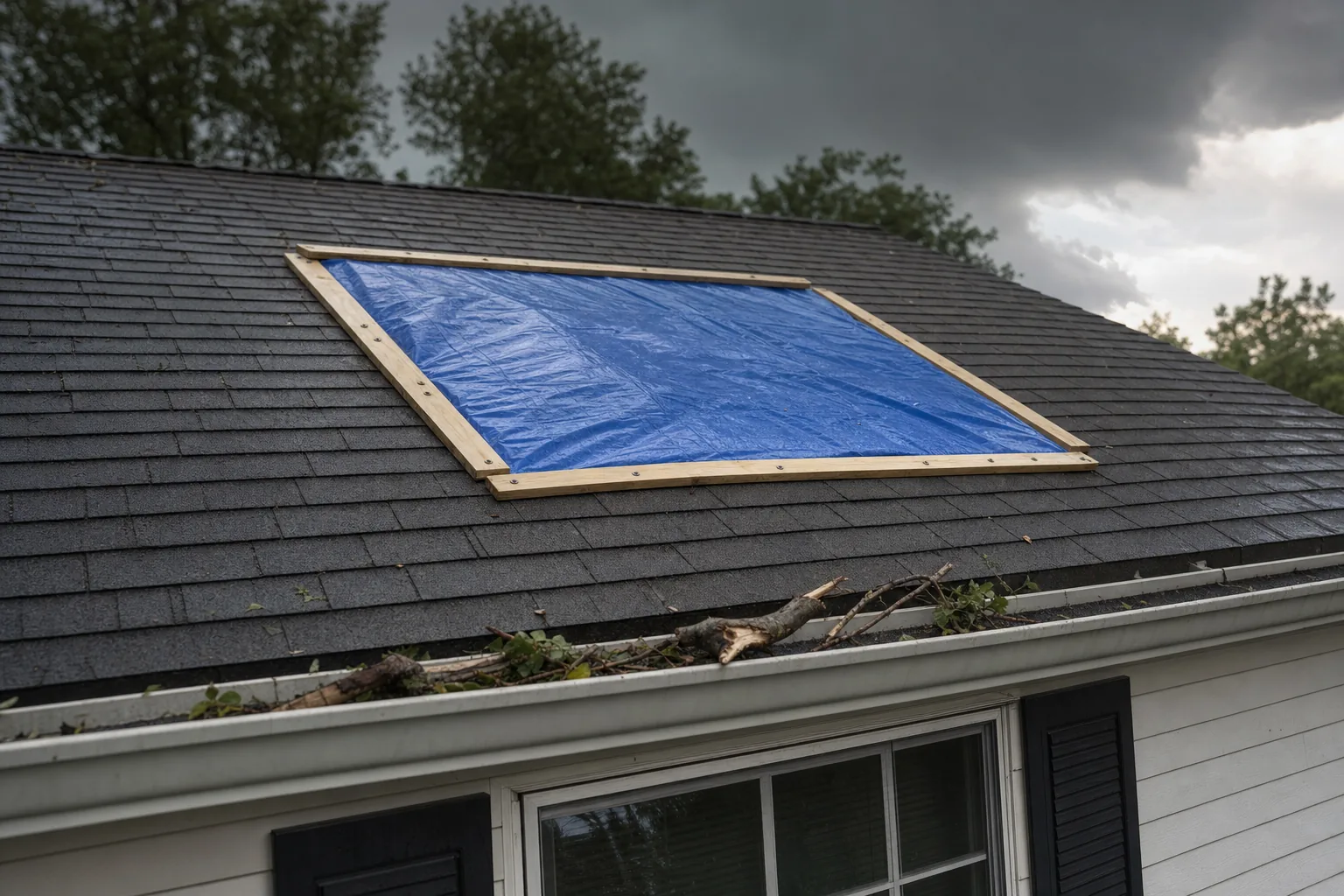
An emergency roof repair exists to stop water entering the building tonight. It is temporary, comparatively cheap, and commits you to nothing. A tarp fastened over a damaged section buys the week or two you need to get quotes in daylight. Needing an emergency repair does not mean needing a new roof.
This is the part worth being clear about, because it is where people get pushed into decisions at the worst possible moment.
An emergency repair exists to stop water entering the building tonight. That is its entire job. It is temporary, it is comparatively cheap, and it does not commit you to anything. A tarp properly fastened over a damaged section, a section of underlayment tacked down, a failed flashing sealed: these buy you the week or two you need to get quotes in daylight from people who are not standing in your living room while the ceiling drips.
A roofer who arrives for an emergency call and leads with a replacement contract has misread the assignment. The sequence should be:
- Stop the water. Tarp or temporary patch, same visit.
- Document everything. Photographs of the damage and of the temporary work, before anyone tidies up.
- Assess properly in daylight, ideally including the attic side.
- Then decide repair or replacement, with quotes, unhurried.
Keep the receipt for the emergency work. Insurers generally expect you to take reasonable steps to prevent further damage, and temporary repairs are normally treated as part of the claim rather than something you have spent instead of it. Check your own policy for its notice requirements, because those vary and some are shorter than people assume.
The pressure tell. Urgency about the leak is legitimate. Urgency about the contract is not. Nothing about a signed replacement agreement stops water coming in faster than a tarp does, and any roofer who cannot separate those two things is selling rather than fixing.
What Middle Tennessee does to roofs specifically
The failure pattern here is not gradual wear so much as repeated stress. Heavy spring rain, hail, summer heat that cooks asphalt, then freeze-thaw cycling through winter. That combination ages a roof unevenly: south and west elevations typically fail first, and the damage often shows up as granule loss and brittleness before anything actually leaks. We charted that cycle against expected lifespans city by city.
After a hail event specifically, the useful thing to know is that hail damage is frequently not visible from the ground and frequently does not leak immediately. Bruised shingles shed granules, the mat underneath degrades, and the failure can surface seasons later rather than immediately. That is why post-storm inspections matter even when nothing is dripping, and why a roof that looks fine from the driveway can still have a legitimate claim.
Questions worth asking before you agree to anything
- How many layers are on the roof now? If they have not checked, they have not assessed it.
- What percentage of the roof area is actually affected? Ask for the number, not an adjective.
- Did you inspect the decking, and from where? Attic access tells a different story than the surface does. If you want a second opinion from someone with nothing to sell, here is what a paid roof inspection costs.
- If you are recommending replacement, which of these is driving it: age, extent, deck condition, or the layer count?
- Will this need a permit? Over a third of the roof area in Nashville, it will.
- What does the repair option look like, and how long would you expect it to hold? Every honest roofer can answer this even when recommending replacement.
- Can I see your license number? Then check it yourself against the state register.
Common questions
Can I just repair part of my roof, or does it all have to match?
You can repair part of it. Matching is the practical problem: shingles fade, product lines get discontinued, and a repair on a ten-year-old roof will usually be visible. That is a cosmetic consideration rather than a structural one, and it matters most on a front elevation. Ask to see the replacement shingle against the existing roof before work starts.
Does a repair void my roof warranty?
It depends what kind of warranty you have. A manufacturer’s material warranty generally covers the product, and a competent repair using compatible materials does not void it. A workmanship warranty from the original installer may be a different matter if someone else does the work. Ask both questions before the repair, not after.
My roof is 15 years old and has one leak. Repair or replace?
Almost certainly repair, unless the deck is wet or you are already at two layers. One leak on a fifteen-year-old roof is usually flashing, and flashing is a repair. Be more cautious if it is the second leak in two years, which suggests the roof is failing rather than damaged.
Insurance is paying: should I just take the replacement?
If the insurer has assessed the damage as warranting replacement, that is their determination to make and it is generally reasonable to accept it. What is worth resisting is a contractor encouraging you to claim for a replacement when the damage is a repair. That is the homeowner’s exposure, not theirs.
How long can a tarp stay on?
Weeks, not months. A properly fastened tarp is a genuine temporary measure and it will hold through normal weather, but it degrades in sun and can lift in wind. Treat it as buying decision-making time rather than as a solution, and get the permanent work scheduled while it is up.
The short version
Age, extent, deck. Under a quarter of the roof, inside its expected life, deck sound, one layer or two: that is a repair, and code is not an argument against it. Systemic problems, a compromised deck, or a third layer that cannot legally go on: that is a replacement.
And if it is midnight and water is coming in: stop the water, photograph everything, and make the expensive decision in daylight.
When you are ready to compare, our Nashville roofing directory lists every roofing company we track with its state license number and expiry, ranked on a published formula, and you can browse roofers across Middle Tennessee or read our breakdown of what an asphalt shingle roof costs here.
Sources
- International Residential Code: the 25 percent / 12-month provision (§R908.4 in the 2024 edition; §R908.3.1 in the 2018 and 2021 editions), and the requirement to strip to deck where the existing roof already carries two or more applications of roof covering.
- Metro Nashville Department of Codes and Building Safety: permit schedule (“roofing, new layer or replacing more than 1/3 of the roof”) and adopted codes list (2024 IRC and 2024 IBC, ordinance BL2025-898).
- National Roofing Contractors Association: expected service life guidance and repairability of flashings and localised damage.
- Tennessee Department of Commerce and Insurance: contractor license register.