What a Deck Costs to Build in Middle Tennessee
A new deck costs $25 to $50 per square foot installed. A 12 by 12 foot deck runs about $3,600 to $7,200. A 20 by 20 lands around $10,000 to $20,000. Replacing an old deck costs a little more than building new, at $30 to $55 per square foot, because somebody has to tear the old one out first.
That is the short answer. The rest of this is what actually moves the number, which parts get left off quotes, and when Metro Nashville makes you pull a permit.
The short version
- Size is not the biggest factor. Height is. A deck sitting near the ground costs $25 to $30 a square foot. The same deck on the second storey costs $50 to $60.
- Material is the second biggest. Pressure-treated pine starts at $25 a square foot. Composite starts at $40.
- Stairs and railings are separate and are the two things most often missing from a cheap quote.
- In Nashville, building or replacing a deck needs a permit. So does replacing more than 100 square feet of deck boards.
What it costs by size
These are for pressure-treated pine, attached to a one-storey house. That is the most common deck built around here.
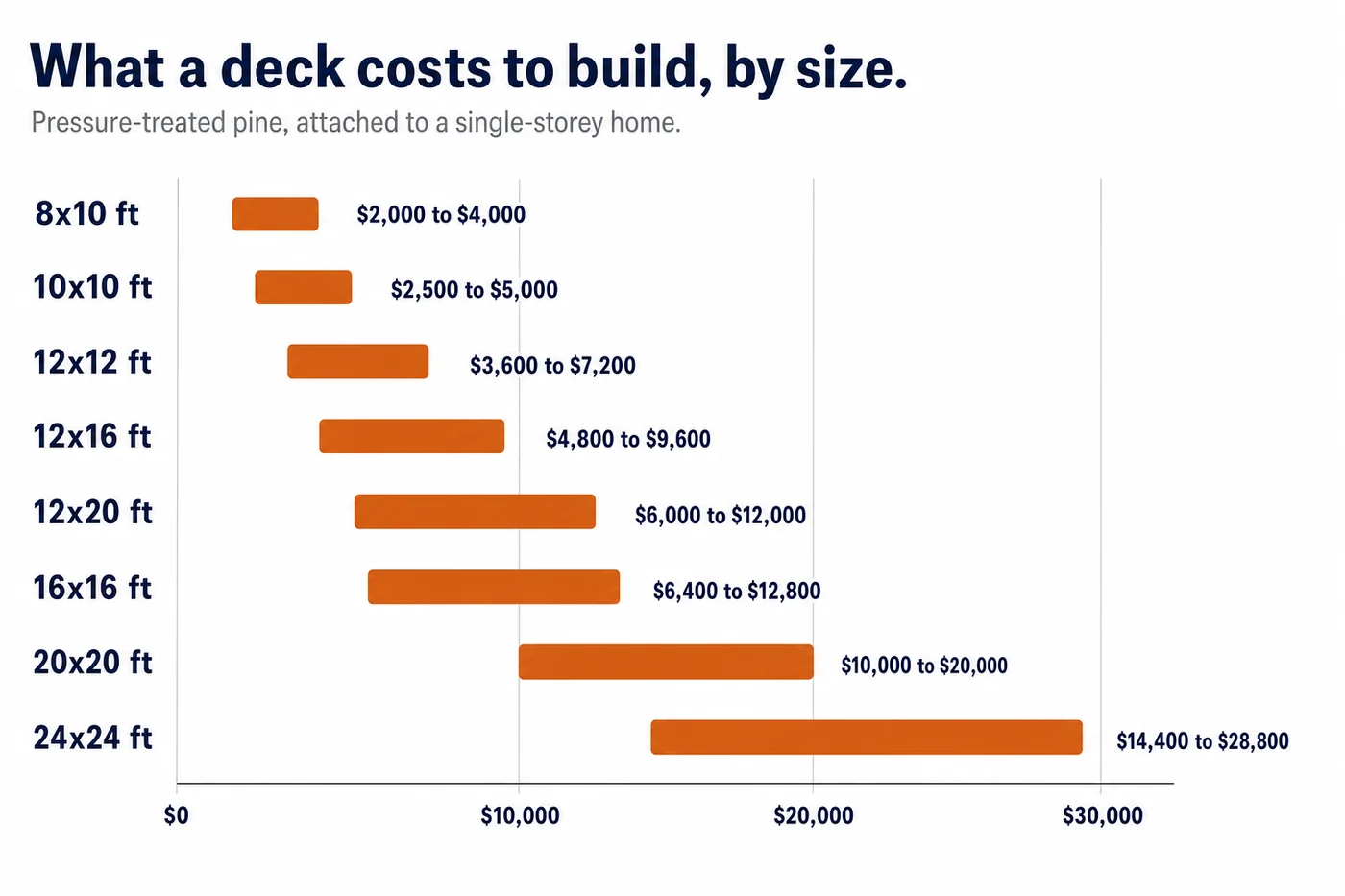
Notice the ranges are wide. A 20 by 20 deck can cost $10,000 or $20,000, and that is the same deck in square feet. The difference is everything below.
What actually moves the price
How high off the ground it sits
This is the one most people do not expect. Height matters more than size.
| Type of deck | Per square foot |
|---|---|
| Floating or detached, no rails or stairs | $20 to $25 |
| Ground level, attached | $25 to $30 |
| Raised, attached | $30 to $50 |
| Second storey, attached | $50 to $60 |
| Multi-level | $60 to $100 |
A second-storey deck costs roughly twice what a ground-level one does. The reason is simple. It needs big posts, a deeper concrete foundation to hold it up, railings by code, stairs down to the yard, and a crew working off ladders and scaffolding instead of standing on the grass.
If your budget is tight and your yard allows it, building low is the single biggest saving available.
This bites hardest in the hillier, newer subdivisions. A walkout basement means the back of the house sits well above the yard, so the deck off the kitchen is a raised or second-storey build whether you wanted one or not. That is common in Nolensville, Spring Hill and parts of Green Hills, and it is why two neighbours with identical square footage can get quotes thousands apart.
What it is made of
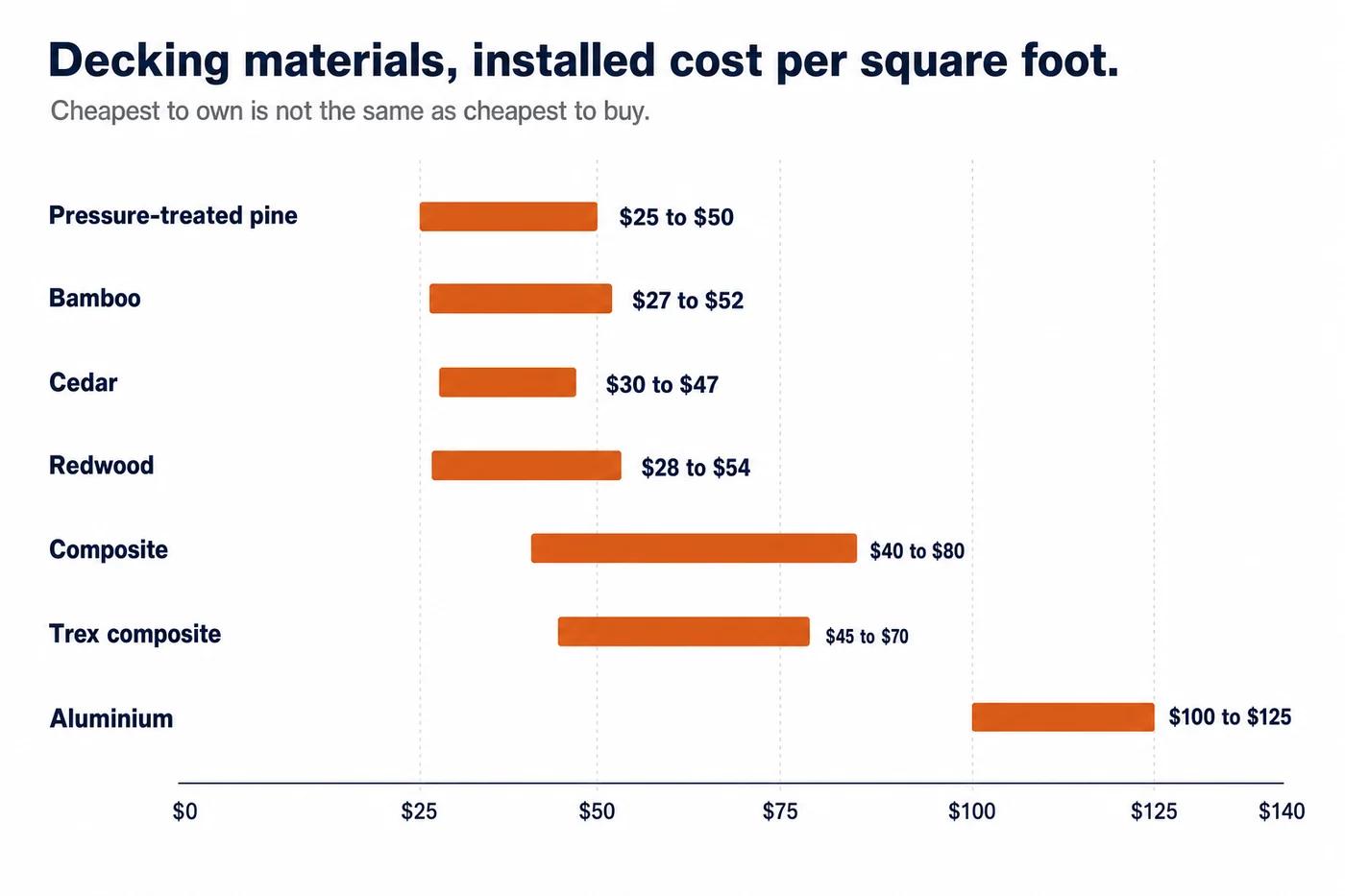
Pressure-treated pine is the default and the cheapest, at $25 to $50 a square foot. It is wood soaked with chemicals so bugs and rot leave it alone. The catch is maintenance: it wants staining and sealing every year, and a wood deck lasts 10 to 25 years.
Cedar runs $30 to $47. It resists weather and bugs on its own with no chemicals, and it takes stain nicely. It is soft, though, so it dents and scratches, and it still needs resealing every year.
Composite runs $40 to $80, and Trex, the best-known brand, runs $45 to $70. Composite is recycled wood and plastic pressed together. It costs more up front and it does not need resealing every year. A composite deck lasts 25 to 50 years, which is roughly double a wood one. Most Trex products carry a 20 to 25 year warranty.
Here is the trade in plain terms. Composite costs about $15 more per square foot than pine. On a 12 by 12 deck that is roughly $2,200 more at the start. In exchange you skip a yearly staining job and the deck lasts about twice as long.
Aluminium is the outlier at $100 to $125. Almost nobody builds a whole deck from it here. It does not rot, burn or feed insects, but the price keeps it rare.
The parts people forget
These are genuinely separate line items. If a quote looks cheap, check whether it includes them.
- Stairs: $1,400 to $2,600 installed.
- Railings: $20 to $60 per linear foot for wood or vinyl. A raised deck must have them by code, so this is not optional.
- Tear-out of the old deck: the reason replacement costs $30 to $55 a square foot instead of $25 to $50.
- Levelling the yard first: $500 to $1,000.
- A roof over it: $10 to $60 per square foot.
- Staining or sealing: $1.50 to $4.00 per square foot, and it comes round again every year or two on a wood deck.
- The permit: $50 to $150.
Drainage, which matters more here than in drier places
Middle Tennessee is wet. Water pooling under a deck rots the posts holding it up, and that is a structural problem rather than a cosmetic one.
If your yard holds water where the deck is going, deal with it before the deck goes on top. A drainage system starts around $1,000. That is real money, but it is far less than rebuilding a deck whose supports rotted out in eight years.
One thing to ask about directly: posts should not be buried straight in the ground. They sit on concrete footings. A crew that buries posts in dirt is building you a deck with a short clock on it.
When Nashville makes you pull a permit
This part is local and worth getting right, because work done without a permit can have to come back off.
Metro Nashville’s Department of Codes and Building Safety is clear about it:
- Building a new deck needs a permit.
- Replacing a deck needs a permit.
- Replacing more than 100 square feet of deck boards needs a permit, even though you are only swapping boards.
- Replacing any footings or framing needs a permit.
- Tearing a deck down and not replacing it does not need one.
There are also rules about where the deck can sit on your lot. It cannot cross your setbacks or utility easements. An uncovered deck can come within 10 feet of the rear line but has to meet the full side setback. A covered deck has to meet the full rear and side setbacks both.
Outside Davidson County the rules are different. Williamson County, which covers Franklin and Brentwood, sets its own. So do Rutherford County for Murfreesboro and Smyrna, Wilson County for Mt. Juliet, and Sumner County for Hendersonville and Gallatin. Ring your own county before you order materials. The thresholds are not the same.
If you live in a historic district, there may be more to it. Properties in a Neighborhood Conservation Overlay or Historic Preservation Overlay have their own rules, and the Historic Commission is the one to ask. Our Middle Tennessee siding guide covers how those overlays work in more detail.
Can you pull the permit yourself? If you live in the house, or plan to, yes. If the house is owned by an LLC or a trust, or it is a rental or investment property, you can only self-permit work under $25,000. The affidavits have to be notarised.
One more, and it is free: call Tennessee 811 at least three working days before anyone digs. They mark the underground utility lines. Deck footings mean digging holes, and hitting a gas line is a very bad day.
The Codes building division is on 615-862-6550.
Should you repair or replace?
A reasonable rule: replace if the deck is more than 20 years old, or if the repair quote is more than half the price of a new one.
Most deck repairs run $750 to $2,500. Replacing a 20 by 20 deck runs $12,000 to $22,000.
What matters is which part is bad. Boards are the cheap part and they are easy to swap. The frame, the posts and the footings are the expensive part. If the boards are tired but the structure is sound, you are looking at a repair. If the posts are soft at the bottom or the whole thing moves when you walk on it, that is a replacement, and no amount of new decking fixes it.
Is it worth doing yourself?
Materials alone for a 12 by 12 deck run $2,000 to $4,000, against $3,600 to $7,200 to have it built. So you would save somewhere around a third.
A small floating deck close to the ground is the realistic DIY project. It carries less load, usually needs no railings, and a mistake is less dangerous.
Anything attached to the house is a different job. The connection where the deck meets your wall is the part that fails and hurts people when it is done wrong. Height, railings and stairs all have code requirements. And you still need the permit and the inspections either way.
How long will it take?
A simple ground-level deck of 100 to 300 square feet takes about 5 to 7 days of building. A larger raised deck runs 2 to 4 weeks. Add a day or two for tearing out an old one.
Then add the permit, which takes a week or more on its own, and any ground work. If you want the deck for summer, start asking in late winter.
Does it add value?
A wood deck returns about 45 to 55 percent of what it cost when you sell. Composite returns slightly less as a percentage but raises the property value more.
Worth knowing: a deck does not add square footage to your house. It will not show up as extra floor area. It may well raise your property taxes, since it raises what the house is worth.
Common questions
How much does a 20×20 deck cost?
About $10,000 to $20,000 installed in pressure-treated pine on a one-storey house. The spread is that wide because of height and material. Ground level in pine sits near the bottom. Raised, or built in composite, pushes toward the top or past it. Replacing an existing 20 by 20 runs $12,000 to $22,000, because tear-out is extra.
What is the cheapest way to build a deck?
Build it low and build it in pressure-treated pine. A floating deck with no railings or stairs is $20 to $25 a square foot, against $50 to $60 for the same deck on the second storey. Material choice saves less than height does. Keeping the shape a simple rectangle also helps, because every corner and angle is labour.
Do I need a permit to build a deck in Nashville?
Yes for a new deck and yes for replacing one. You also need one to replace more than 100 square feet of deck boards, or to replace any footings or framing. You do not need one to tear a deck down if you are not replacing it. The deck also has to sit inside your setbacks and off your utility easements. Metro Codes is on 615-862-6550.
Is composite decking worth the extra money?
It depends how long you are staying. Composite costs roughly $15 more per square foot, about $2,200 more on a 12 by 12. For that you skip staining and sealing every year, and the deck lasts 25 to 50 years against 10 to 25 for wood. If you are staying more than about a decade, the maintenance you avoid tends to cover the difference. If you are selling in two years, it will not.
How long does a deck last in Tennessee?
A wood deck lasts 10 to 25 years and a composite one 25 to 50. Decks do worse in wet climates, and Middle Tennessee is wet. The two things that decide which end of the range you land on are whether water drains away from underneath and whether the posts sit on proper concrete footings instead of being buried in dirt.
Can I build a deck right on the ground?
Not a wood or composite one. It needs posts or risers underneath so air can move and the timber can dry. Decking left sitting on soil soaks up water and rots. If you genuinely want something at ground level, a patio is the better answer.
Getting it quoted
Compare at least three quotes, and make sure they are quoting the same deck. Questions worth asking:
- Does this include stairs and railings? They are separate items and they are what makes a cheap quote cheap.
- Does it include tearing out and hauling away the old deck?
- What are the footings, and how deep? Posts sit on concrete. They are not buried in soil.
- Who pulls the permit? Get this in writing.
- What happens if the ground needs work? Ask the rate before anyone starts digging.
Check the licence too. Our Middle Tennessee deck builder directory lists every company we track with its state licence number and expiry date, so you can check it against the state register yourself rather than taking our word for it. You can also request free quotes to compare more than one opinion on the same yard, or start with deck builders in Nashville.
Sources
- HomeGuide cost to build a deck, updated 10 February 2026, for the per-square-foot ranges, the cost-by-size table, cost by material, cost by deck type, the labour and materials split, stairs, railings, levelling, drainage, staining and permit costs, build times, deck lifespans, repair against replacement, DIY materials cost and resale return. Retrieved 5 October 2026.
- Metro Nashville Department of Codes and Building Safety, adding a deck or patio to a residence, for what needs a permit and what does not, the 100 square foot deck board threshold, footing and framing replacement, setback and easement rules, the reduced rear setback for uncovered decks, historic overlay referrals, self-permit eligibility and the $25,000 limit for LLC, trust and investment properties, and the Tennessee 811 notice. Page last updated 17 January 2025, retrieved 5 October 2026.
This article is general information, not construction, engineering or legal advice. Permit rules are set by your local jurisdiction and change over time: the rules above are Metro Nashville and Davidson County, and Williamson, Rutherford, Wilson and Sumner counties set their own. Confirm the requirements for your address before you build. Cost figures are national installed ranges and will vary with your yard, your access and your design. Last updated 5 October 2026.