How Long Does a Roof Last in Tennessee Heat and Humidity?
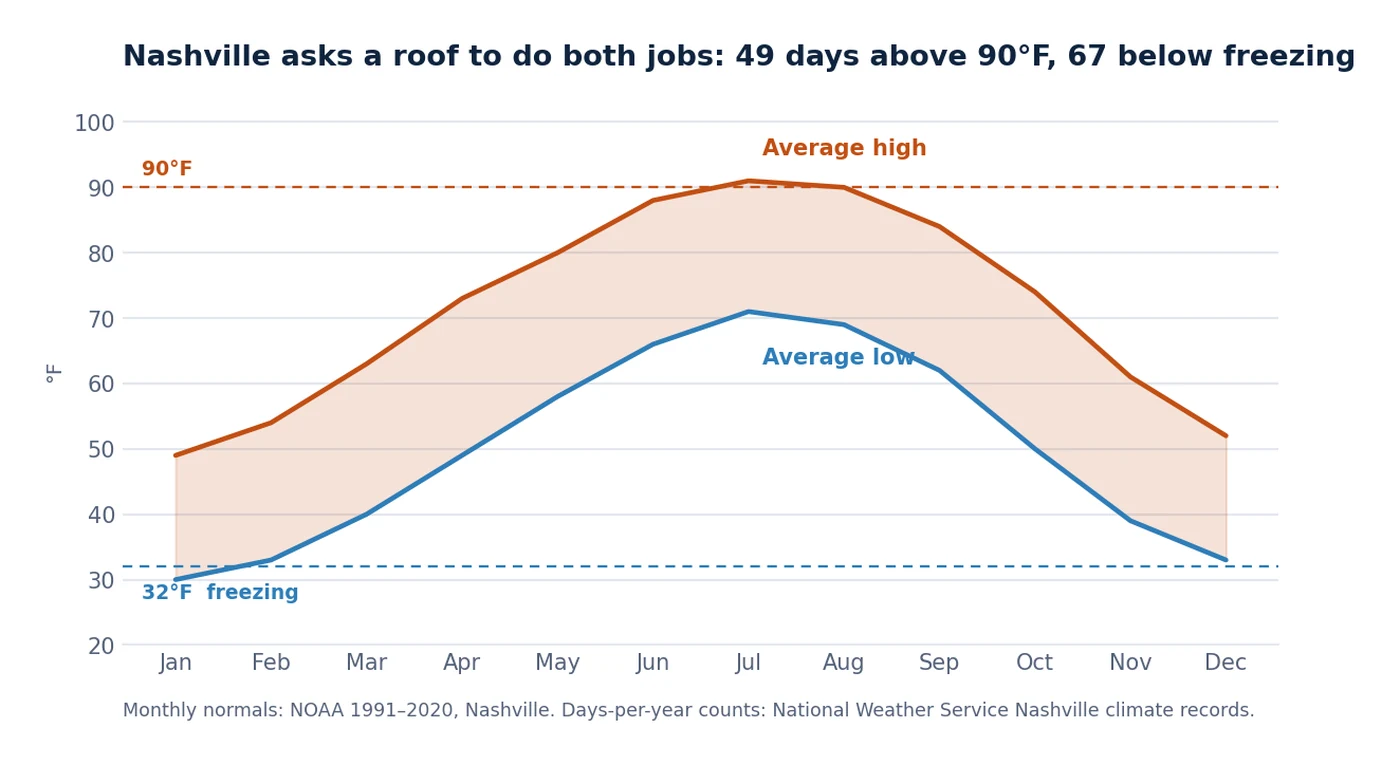
In Middle Tennessee, plan on 15 to 20 years from a 3-tab asphalt roof and 20 to 25 from an architectural one — the lower end of what the same shingles are rated for nationally. Metal runs 40 years and up. The reason is not one extreme season but two: Nashville averages 49 days a year at or above 90°F and 67 days at or below freezing, so a roof here is cooked and then flexed, year after year.
Manufacturers rate shingles under laboratory conditions. Tennessee is not laboratory conditions. This is what the heat and the humidity actually do, how long each material realistically lasts here, and why two roofs on the same street can age a decade apart.
The published numbers, before climate
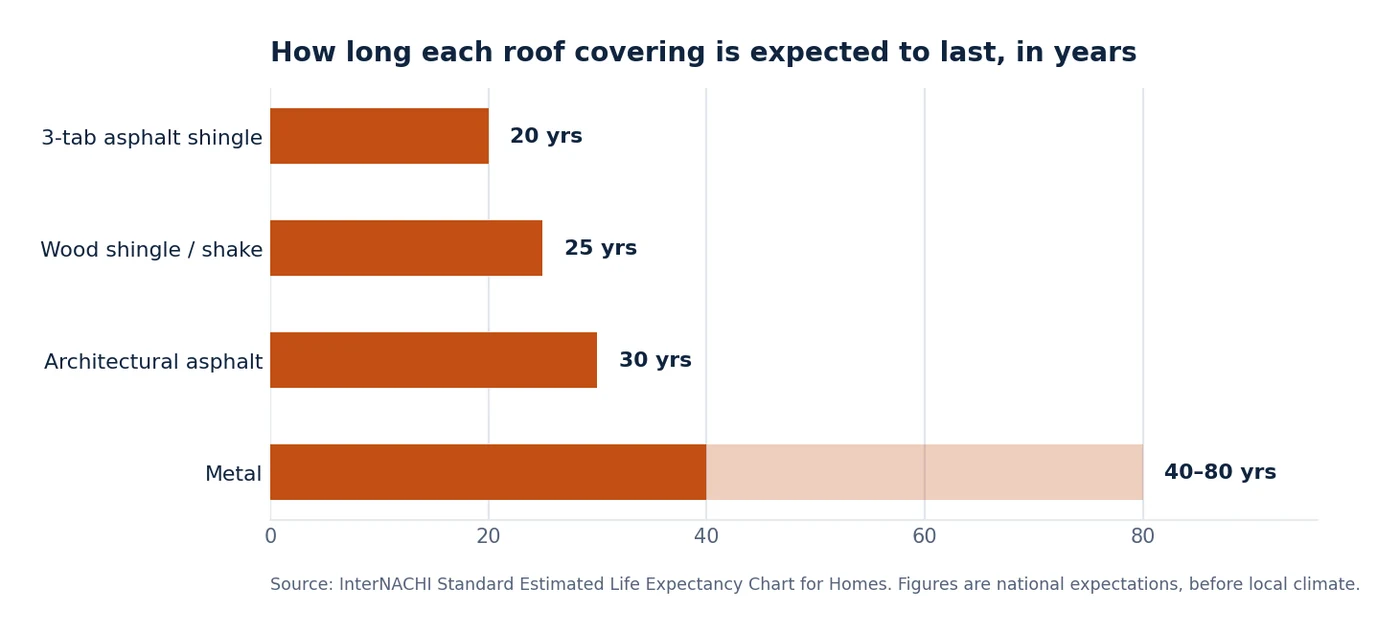
InterNACHI’s life expectancy chart is the standard reference and gives these figures for roof coverings:
| Covering | Published expectation | Realistic Middle TN planning range |
|---|---|---|
| 3-tab asphalt shingle | 20 years | 15–20 |
| Wood shingle or shake | 25 years | 20–25 |
| Architectural asphalt | 30 years | 20–25 |
| Metal | 40–80 years | 40+ |
The middle column is published and citable. The right-hand column is our planning estimate, not a measured figure, and we want to be straight about that: it reflects the direction every degradation mechanism below pushes in, applied to the published life. We did not find published research assigning a specific percentage reduction to this climate, and we are not going to invent one.
Why Middle Tennessee is hard on a roof
Heat drives the volatiles out
Asphalt shingles stay flexible and waterproof because of volatile compounds in the asphalt. Heat accelerates the rate at which those evaporate. As InterNACHI puts it, shingles “become more brittle as volatiles, which keep them flexible, dissipate,” and that loss “can degrade the bond between the asphalt and the granules.”
Once the bond weakens, granules wash off. Granules are the shingle’s sunscreen, so losing them exposes the asphalt to more UV, which drives off more volatiles. It is a loop that accelerates rather than a steady decline, which is why roofs here often look fine for years and then deteriorate noticeably fast.
Air temperature understates it. A dark roof in direct July sun runs far hotter than the 91°F on the thermometer, and InterNACHI notes that “darker roofs absorb more heat, which shortens shingle lifespan by accelerating the loss of volatiles and increasing thermal cycling.”
Then the cold flexes what the heat made brittle
This is the part people miss about Tennessee. We are not Phoenix. Nashville has 67 days a year at or below freezing alongside those 49 days above 90°F, and InterNACHI is explicit that “climates with large daily temperature swings shorten roof lifespans because they cause greater amounts of expansion and contraction.”
A shingle that has lost volatiles to summer heat is less able to absorb that movement. Brittle material plus repeated flexing is how you get the splitting and cracking that shows up on older Middle Tennessee roofs, often before anything leaks.
Humidity brings something that eats the shingle
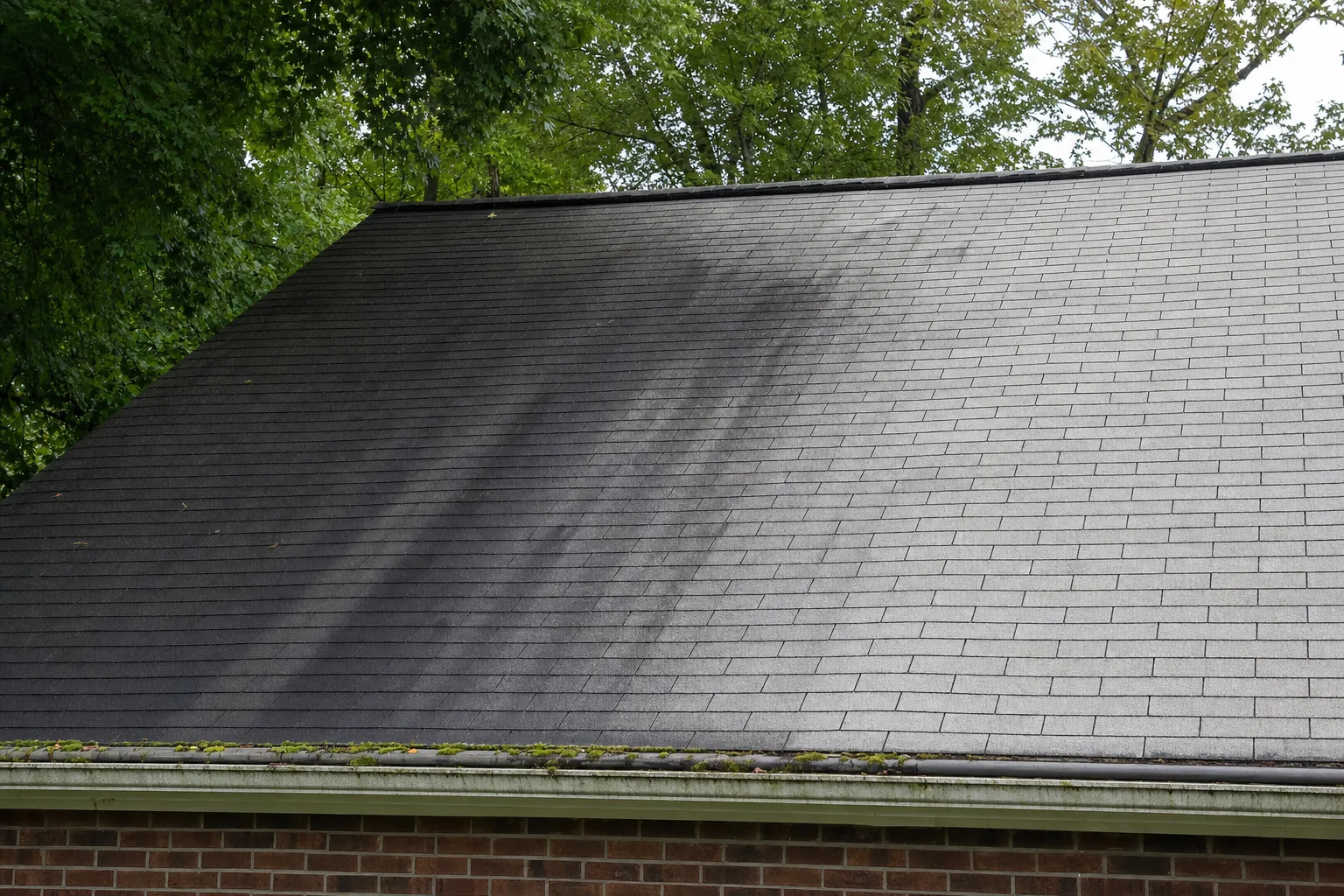
Those black streaks on roofs all over Middle Tennessee are not dirt. They are Gloeocapsa magma, a cyanobacteria, and the Asphalt Roofing Manufacturers Association identifies it as the common cause of the discolouration. The Southeast is among the highest-risk regions precisely because humidity spikes alongside summer heat.
It matters beyond appearance. The organism feeds on the limestone filler that gives an asphalt shingle its weight, and as it does, surface granules loosen and wash away with rainfall — the same granule loss that heat causes, arriving by a different route. It takes hold first where the roof gets least sun and stays damp longest, which is why it shows up on north-facing slopes and under tree cover.
The two slopes of the same roof age differently
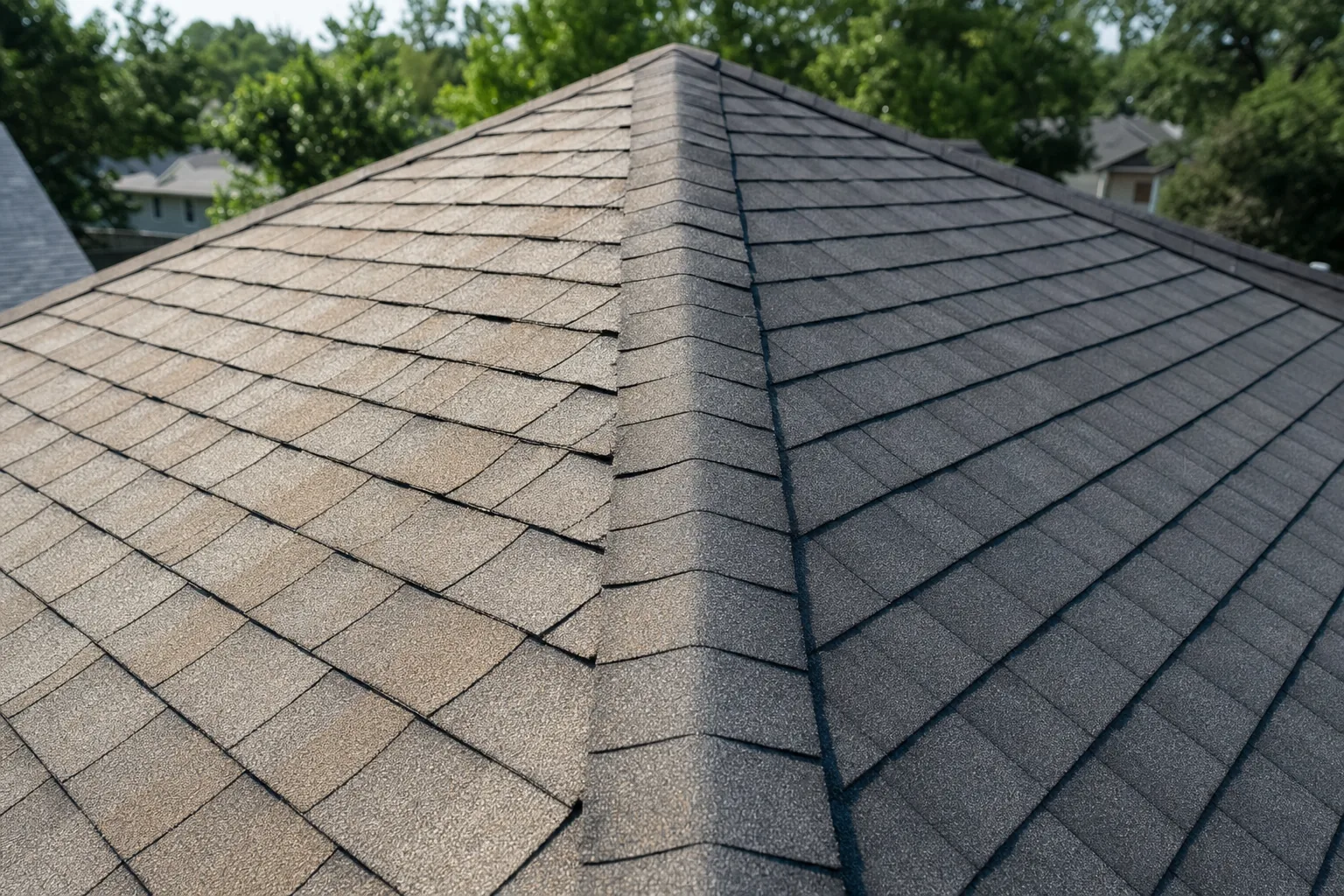
InterNACHI notes that “south-facing roof slopes have shorter lifespans due to increased thermal cycling and UV exposure.” In Middle Tennessee you often get the worst of both on one house: the south slope bakes, and the north slope — cooler and damper — grows algae. When a roofer says your roof needs work but only points at one elevation, this is usually why.
Ventilation is the variable you can actually control
Of everything on this page, attic ventilation is the factor most within a homeowner’s control. Poor ventilation, in InterNACHI’s words, “shortens shingle lifespan by failing to keep shingles cool, resulting in accelerated loss of volatiles and greater amounts of thermal cycling.” A badly ventilated attic in a Tennessee August is an oven pressed against the underside of the roof for weeks at a time.
Does it differ across Middle Tennessee?
Less than people expect. The communities below sit within roughly 40 miles of each other and share the same climate profile, so the material lifespans above apply across all of them. What varies is the housing stock and the tree cover, and those change what you should be watching for.
| Community | County | What to watch |
|---|---|---|
| Nashville | Davidson | The widest mix of roof ages in the metro; heavy tree canopy in older neighbourhoods drives algae and debris |
| East Nashville | Davidson | Older housing stock and mature shade trees — algae streaking and aged decking are the recurring themes |
| Green Hills | Davidson | Dense mature canopy; shaded slopes stay damp and stain early |
| Bellevue | Davidson | Wooded lots west of the city; overhanging limbs and gutter debris hold moisture against the roof edge |
| Antioch | Davidson | Large 1990s and 2000s subdivisions now reaching the end of first-generation shingles |
| Brentwood | Williamson | Larger roof areas with complex hips and valleys; more flashing detail to fail before the field does |
| Franklin | Williamson | A wide span of build dates, from historic to new-build, so roof age varies street to street |
| Nolensville | Williamson | Mostly newer construction; roofs still inside warranty, where ventilation quality shows up first |
| Spring Hill | Williamson / Maury | Rapid recent growth means large numbers of roofs of near-identical age, ageing together |
| Murfreesboro | Rutherford | Open, less-shaded subdivisions — sun exposure and hail matter more than algae here |
| Smyrna | Rutherford | Similar exposure to Murfreesboro; watch south and west slopes first |
| Hendersonville | Sumner | Lakeside humidity adds to the algae picture on shaded elevations |
| Gallatin | Sumner | Mixed older and new stock; storm exposure on the northern side of the metro |
| Mt. Juliet | Wilson | Fast-growing newer housing; ventilation and installation quality are the differentiators |
The column on the right reflects the character of the housing stock rather than a measured difference in roof life. A shingle in Gallatin and a shingle in Spring Hill are rated the same and will last about the same. Where your roof sits on a street, how much shade it gets, which way the slopes face and how well the attic breathes will move the number far more than which of these towns you live in.
Getting to the top of the range instead of the bottom
- Fix the ventilation. Ridge and soffit venting that actually moves air keeps shingle temperature down, which slows volatile loss and reduces thermal cycling. It is the highest-leverage thing on this list.
- Keep the roof clear. Leaf litter in valleys and gutters holds moisture against the roof, which is what algae and moss want.
- Cut back overhanging limbs. Shade keeps slopes damp and drops debris. It also gives squirrels a bridge.
- Consider algae-resistant shingles when you re-roof. In this climate the copper-bearing granule types are addressing a problem you are likely to get, not a hypothetical one.
- Look after a storm, not just after a leak. Hail damage frequently does not leak immediately; it bruises the mat and shortens the life quietly.
- Do not pressure-wash asphalt shingles. It strips the granules you are trying to keep. Algae treatment is a low-pressure chemical job.
Common questions
How long will my roof last in Nashville specifically?
For asphalt shingles, plan on 15 to 20 years from a 3-tab roof and 20 to 25 from an architectural one. Metal runs 40 years and up. Where you land in those ranges depends more on attic ventilation, shade, slope orientation and installation quality than on anything else — two identical roofs installed the same week can differ by years.
Do the black streaks mean I need a new roof?
Not by themselves. The streaks are Gloeocapsa magma, and while it does feed on the shingle’s limestone filler and loosen granules, staining alone is not a replacement trigger. What matters is whether granules are actually going — check the gutters for granule accumulation — and whether the shingles are curling or cracking. Streaking on an otherwise sound roof is a cleaning question.
Does a lighter-coloured roof really last longer here?
Darker roofs absorb more heat, and InterNACHI links that directly to faster volatile loss and increased thermal cycling. So the direction is real. We did not find a figure quantifying how many extra years a lighter roof buys in this climate, so we are not going to put a number on it. If you are choosing anyway, lighter is the direction that helps.
Why does one side of my roof look so much worse?
Because it is being aged by a different mechanism. South-facing slopes take more sun and more thermal cycling, so they fade, dry and lose granules first. North-facing slopes stay cooler and damper, so they grow algae and moss. Same roof, same install date, two different failure paths.
My roof is 18 years old and looks fine. Should I be worried?
Not worried, but you are inside the window where it is worth an inspection rather than a glance from the driveway. Asphalt tends to look acceptable from the ground well past the point where granule loss and brittleness have set in. Check the gutters for granules and look at the south and west slopes first.
Is metal worth it in Tennessee heat?
On lifespan alone, the published range is 40 to 80 years against 20 to 30 for asphalt, so it lasts considerably longer. It costs correspondingly more up front, and whether that trade works depends on how long you plan to own the house. It is not affected by the algae problem at all.
The short version
Tennessee ages a roof from two directions. Summer heat drives out the volatiles that keep shingles flexible and loosens the granules that shield them; winter cold then flexes what the heat made brittle, 67 days a year. Humidity adds an organism that eats the shingle’s filler from the shaded side. Expect the lower end of the published range, and expect the south and north slopes of the same roof to fail for opposite reasons.
The one lever that genuinely moves the number is ventilation.
When you want it looked at, our Nashville roofing directory lists every roofing company we track with its state licence number and expiry, and you can browse roofers across Middle Tennessee, work out whether you need a repair or a replacement, or see what a new roof costs here.
Sources
Climate figures read 21 September 2026. Lifespan figures are published national expectations; the Middle Tennessee planning ranges are our estimate and are labelled as such above.
- InterNACHI — Standard Estimated Life Expectancy Chart for Homes (covering lifespans)
- InterNACHI — Mastering Roof Inspections: Asphalt Composition Shingles (volatiles, thermal cycling, ventilation, orientation)
- National Weather Service Nashville — BNA climate records (49 days ≥90°F, 67 days ≤32°F)
- NOAA 1991–2020 climate normals for Nashville (monthly average high and low)
- Asphalt Roofing Manufacturers Association — Algae Discoloration of Roofs