Roofing Scams in Nashville: The Tennessee Law Storm Chasers Hope You Have Not Read
If a roofing contractor in Tennessee asks you for money up front on an insurance job, that is not just a warning sign — state law says they cannot do it. Under T.C.A. § 62-6-604, a residential roofing services provider cannot require any payment until your insurer has confirmed in writing that the claim is fully covered, or the three-business-day cancellation window has passed.
Tennessee wrote an entire part of its code for this problem after a wave of storm-chasing roofers. Most homeowners have never heard of it, which is exactly why it keeps working on people. This is what those six sections actually say, what a storm chaser looks like in Middle Tennessee, and what to do in the days after a hailstorm when someone is already knocking.
Why this happens here, in waves
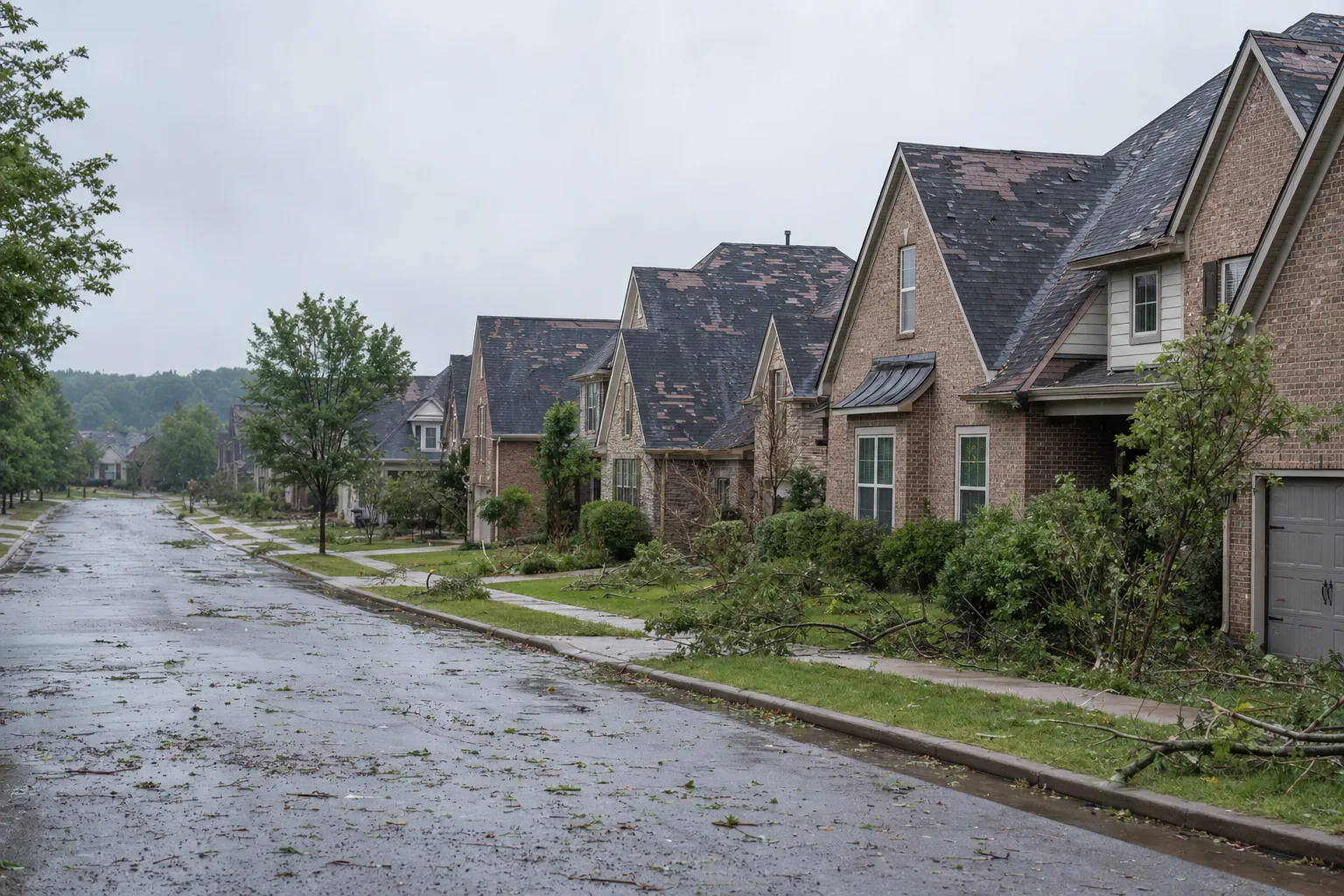
Roofing fraud in Middle Tennessee is not a steady background rate. It arrives with the weather. The Tennessee Attorney General issued scam warnings after the March 2020 Nashville tornado and again after the October 2024 flooding. Clarksville police warned residents about roofing and contractor scams following severe weather. The state runs a Contractor Fraud Awareness Week every year, held 19–23 May in 2025.
We could not find reliable figures for how many Nashville homeowners are defrauded each year, and we are not going to invent one. What the public record does show is a repeating pattern of official warnings, local investigations and state law written specifically for this problem — including a NewsChannel 5 investigation into a roofer accused of home improvement fraud in the Nashville area who had a history of problems in other states. That last detail is the whole shape of it: the out-of-town crew that follows the storm.
Five things Tennessee law already gives you
Title 62, Chapter 6, Part 6 of the Tennessee Code is called Residential Roofing Services. It was passed in 2012 and it is short. Here is what is in it.
1. They cannot take your money up front
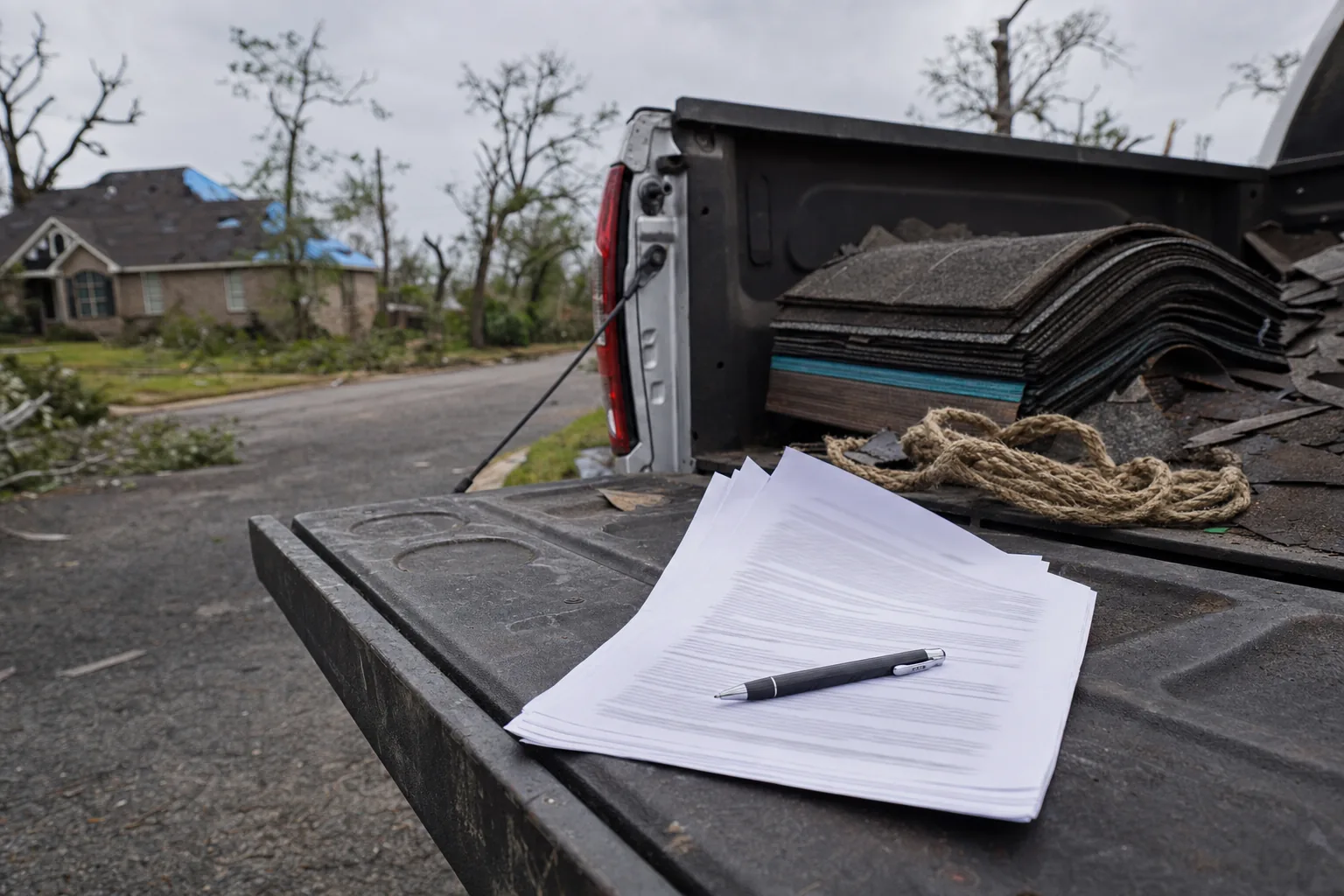
“No residential roofing services provider shall require any payments from a person pursuant to a contract until the person has received written notice from the insurer that the contract or claim is fully covered or the three-day cancellation period required pursuant to this part has expired.” — § 62-6-604(a)
This is the one to remember. The classic storm-chaser move is a deposit taken on the driveway, followed by silence. On an insurance roofing job in Tennessee, that deposit is not something to be wary of — it is something the provider is not permitted to require.
There is one carve-out, and it is narrow: if the contractor performs emergency repairs that you have acknowledged in writing were necessary to prevent damage, they may collect for those at the time the work is done (§ 62-6-604(c)(1)). Tarping a hole at midnight can be paid for. A deposit toward the re-roof cannot.
2. They cannot invent the emergency either
“No residential roofing services provider shall misrepresent that emergency repairs are necessary to prevent damage to the residential real estate owned or possessed by such person.” — § 62-6-604(c)(2)
Since emergency repairs are the one payment a contractor can collect immediately, the statute closes the obvious loophole: manufacturing the emergency to unlock it.
3. You can cancel if your insurer says no — or only partly yes
Under § 62-6-602, once you receive written notice from your insurer that all or any part of the claim is not a covered loss, you may cancel the contract. You have until midnight on the third business day after receiving that notice.
Note the words any part. This is not limited to a flat denial. A partial denial triggers the same right, which matters because partial coverage is the more common outcome and the one people assume they are stuck with.
The cancellation notice needs no special wording. The statute says it need only be signed, dated, and indicate “by any form of written expression” that you do not intend to be bound. Mail it and it counts from the postmark; email or fax it and it counts from the moment you send it.
Once you cancel, any payments you have made — other than for emergency repairs already performed — must be returned within ten business days.
4. They must hand you their licence number before you sign
This is the provision most homeowners do not know exists, and it is the one that catches out-of-state storm chasers. Before entering a contract, § 62-6-603 requires a residential roofing services provider to give you, in writing:
- A business mailing address for cancellation purposes, and a telephone number
- The licence or registration number of any contractor, home improvement contractor, or public adjuster licence they hold — in this state or any other state
- An email address or fax number for cancellation, if they have one
- A detailed description of all damage or repairs to be claimed or covered by the contract, and the location of that damage
- A written cancellation statement in boldface type of at least 10 points
- A detachable “NOTICE OF CANCELLATION” form, in duplicate, also in 10-point boldface
Two of those are quietly powerful. The licence requirement covers other states, so a crew from out of state cannot simply say they are not licensed here and move on. And the written description of damage, with its location, gives you a dated record of what they claimed was wrong before any work started — which is the natural check on damage that grows between the inspection and the invoice.
5. They cannot play insurance adjuster unless they are one
“No residential roofing services provider shall act or hold out as being a public adjuster … unless licensed as a public adjuster in accordance with title 56, chapter 6, part 9.” — § 62-6-605
“We’ll handle the whole claim for you, you don’t need to talk to your insurer” is a sales pitch that runs into this section. Negotiating your claim on your behalf is public adjusting, and it requires its own licence.
And there are teeth
Under § 62-6-606, a violation of any of the above is an unfair or deceptive act under the Tennessee Consumer Protection Act of 1977. That statute carries a private right of action for anyone who suffers an ascertainable loss — meaning you are not limited to filing a complaint and hoping.
The patterns, and which rule each one runs into
| What it looks like | Where it runs into the law |
|---|---|
| Large deposit requested on the spot | § 62-6-604(a) — no payment required before full-coverage notice or expiry of the cancellation window |
| “This is an emergency, we need to start today” | § 62-6-604(c)(2) — misrepresenting that emergency repairs are necessary is prohibited |
| Pressure to sign before the adjuster has seen the roof | § 62-6-602 — you keep a cancellation right once the insurer’s written decision arrives |
| Vague about who they are or where they are based | § 62-6-603(1) — written address, phone and licence numbers required before signing |
| “We’ll deal with your insurance company directly” | § 62-6-605 — public adjusting requires a public adjuster licence |
| Damage that seems to grow after a “free inspection” | § 62-6-603(2) — the written description and location of damage is required up front |
One tactic on the usual list sits outside this Part: an offer to cover, waive or absorb your insurance deductible. We are not going to tell you what Tennessee law says about that, because we did not verify it, and unverified law is worse than none. Treat it as a straightforward red flag regardless: the deductible is the part of the loss your policy says you carry, and a contractor offering to make it disappear is describing something to your insurer that is not what is happening.
Licensing, and why the answer depends on your county
Tennessee’s Home Improvement licence covers residential remodelling projects from $3,000 to $24,999 — but only in counties that adopted the law. The Department of Commerce and Insurance lists those counties as Bradley, Davidson, Hamilton, Haywood, Knox, Marion, Robertson, Rutherford and Shelby.
For Middle Tennessee that is worth reading twice. Davidson County (Nashville) and Rutherford County (Murfreesboro) are on that list. Williamson, Sumner and Wilson counties are not among the nine. A roofer working in Franklin, Hendersonville or Mt. Juliet is operating under different requirements from one working in Nashville, on the same size of job.
Larger projects require a contractor licence rather than a home improvement licence. The state’s own page does not publish the dollar threshold for that, so we are not going to state a figure we cannot source — ask the contractor which licence they hold for the size of your job, and check it.
Checking a licence takes under a minute
- Ask for the number before the quote. On an insurance roofing job they are required to give it to you in writing before you sign anyway.
- Search it at search.cloud.commerce.tn.gov, the state’s public register.
- Check the expiry date, not just the status. A record can read “Active” while sitting past its expiry, because the status only reflects when the record was last touched.
- Check the name matches. Companies trade under one name and register under another. If the register shows a different entity, ask them to explain the connection.
- Match on name and city, not the number alone. Licence numbers are not unique across licence types — searching one number we got a roofing company, a cosmetologist and a former motor vehicle salesman.
The first 48 hours after a storm
- Stop the water, and nothing more. Emergency tarping is legitimate and payable on the spot. It commits you to nothing else.
- Photograph everything before anyone tidies up, including the temporary work.
- Call your own insurer first, not a number on a flyer.
- Do not sign anything on the driveway. No signature is required to get an inspection or a quote.
- Get the written pack § 62-6-603 entitles you to — address, phone, licence numbers, damage description, cancellation notice. A provider who cannot produce it has told you something useful.
- Get more than one quote. Urgency about a leak is real; urgency about a contract is a sales technique.
If you have already signed
You may still have a route out. If your insurer has sent written notice that all or part of the claim is not covered, the three-business-day cancellation clock under § 62-6-602 starts from when you received it. The notice needs no particular wording — signed, dated, and clear that you do not intend to be bound.
If money has changed hands and the work has not been done, § 62-6-604(b) requires it returned within ten business days of your cancellation, except for emergency repairs already performed.
Complaints go to the Tennessee Department of Commerce and Insurance, and to the Attorney General’s Division of Consumer Affairs. Because § 62-6-606 routes violations through the Consumer Protection Act, a private right of action is also available to someone who has suffered an ascertainable loss — that is a conversation for an attorney, not for us.
Common questions
A roofer knocked on my door after the storm. Is that itself illegal?
No. Door-knocking after a storm is normal and plenty of legitimate local companies do it. What matters is what happens next: whether they hand you the written pack § 62-6-603 requires, whether they ask for money before your insurer has confirmed coverage, and whether their licence checks out on the state register. Judge the conduct, not the knock.
They want a deposit to “get me on the schedule”. Is that allowed?
On a residential roofing contract tied to an insurance claim, § 62-6-604(a) says a provider cannot require any payment until your insurer has given written notice that the claim is fully covered, or the three-business-day cancellation period has expired. Scheduling pressure does not change that. Emergency repairs you have acknowledged in writing as necessary are the exception, and they are payable when the work is done.
My claim was only partly approved. Can I still cancel?
Yes. Section 62-6-602 applies when you receive written notice that “all or any part” of the claim is not a covered loss. Partial denial triggers the same three-business-day right as a full one.
Does the contractor have to be licensed in Tennessee specifically?
Section 62-6-603 requires them to give you, in writing before you sign, the licence or registration number of any contractor, home improvement contractor or public adjuster licence they hold in this state or any other. Whether a particular job needs a Tennessee home improvement licence depends on project value and county: that licence covers $3,000 to $24,999 and applies only in the nine counties that adopted it, which include Davidson and Rutherford. Ask which licence they hold for your job, then verify it.
The contractor offered to “take care of” my deductible. Should I be worried?
Treat it as a red flag. Your deductible is the share of the loss your policy says you carry; a contractor making it disappear generally means the amount billed to your insurer does not match what you actually paid. We have not verified what Tennessee law specifically says about deductible waivers, so we are not going to characterise its legal status — but ask your insurer directly before agreeing to anything of the sort.
How long do I have to file the insurance claim itself?
That is set by your policy rather than by this Part of the code, and notice periods vary between insurers. Read your own policy or ask your agent. The three-business-day clock discussed here is about cancelling the roofing contract, not about filing the claim.
The short version
Tennessee already wrote the protections. No money up front on an insurance job. Licence numbers and a written damage description before you sign. Three business days to cancel once your insurer’s written decision lands, including a partial denial. Ten business days to get your money back. And a violation is an unfair or deceptive practice you can sue over.
The storm chaser’s business model depends on none of that being known on the driveway at the moment of signing.
When you are ready to compare, our Nashville roofing directory lists every roofing company we track with its state licence number and expiry date, and you can browse roofers across Middle Tennessee or read our guide to telling a repair from a replacement.
Sources and scope
This article is informational and is not legal advice. Statutory text was read against the 2025 Tennessee Code on 21 September 2026. Laws change; verify before relying on any of it, and speak to an attorney about your own situation.
Statutes read in full: T.C.A. §§ 62-6-601 through 62-6-606 (Title 62, Ch. 6, Part 6 — Residential Roofing Services), all enacted by Acts 2012, ch. 821, § 2, with § 62-6-605 amended by Acts 2013, ch. 355, § 5. Our check covered the statutory text of those six sections only. Case law interpreting them, and any provision governing insurance deductible waivers, sat outside that scope.
- T.C.A. Title 62, Ch. 6, Part 6 — Residential Roofing Services (2025)
- TN Dept. of Commerce & Insurance — Home Improvement licensing
- Tennessee contractor licence register
- TN Attorney General — scam warning after October 2024 flooding
- TN Attorney General — scam warning after the March 2020 tornado
- TN Contractor Fraud Awareness Week, 19–23 May 2025
- NewsChannel 5 — roofer accused of home improvement fraud
- NewsChannel 5 — Clarksville police warning